Δευτέρα, Ιουλίου 31, 2006


news in.gr - Στο Ευρωπαϊκό Δικαστήριο η Ελλάδα για τους βιολογικούς καθαρισμούς

Στο Ευρωπαϊκό Δικαστήριο η Ελλάδα για τους βιολογικούς καθαρισμούς


Αθήνα
    Στείλε το άρθρο με emailΤύπωσε το άρθρο
Στο «σκαμνί» του Ευρωδικαστηρίου θα καθίσει η Ελλάδα, αυτή τη φορά γιατί 24 πόλεις δεν διαθέτουν αποχέτευση και εγκαταστάσεις δευτεροβάθμιας επεξεργασίας λυμάτων -παρ' ότι «η Ελλάδα δικαιούται και έχει λάβει σημαντική κοινοτική χρηματοδότηση από τα Διαρθρωτικά Ταμεία και το Ταμείο Συνοχής» όπως χαρακτηριστικά αναφέρεται.

Η κοινοτική Oδηγία ήταν σαφής: «Oι πόλεις και οι κωμοπόλεις με πληθυσμό άνω των 15.000 κατοίκων οφείλουν να διαθέτουν αποχετευτικά δίκτυα για τη συλλογή των λυμάτων τους, καθώς και εγκαταστάσεις βιολογικού καθαρισμού των λυμάτων, ώστε οι ρύποι να απομακρύνονται πριν από τη διοχέτευσή των λυμάτων στη θάλασσα ή στα γλυκά νερά».

Ωστόσο, όπως γράφουν τα Νέα, η ελληνική πρακτική υπήρξε διαφορετική. Η προθεσμία για τη δημιουργία των απαραίτητων υποδομών έληξε προ 6ετίας χωρίς αποτέλεσμα. Η κυβέρνηση δεν έδειξε να ανταποκρίνεται στις κοινοτικές επιταγές, ούτε μετά τη γραπτή προειδοποίηση για παράβαση της Oδηγίας, που έλαβε τον Ιούλιο του 2005.

Ενδεικτικό είναι πως στην απόφαση παραπομπής της χώρας για το θέμα αυτό, «από την απάντηση των ελληνικών Αρχών, σε ορισμένες περιοχές- π.χ. Άρτεμις, Ραφήνα, Νέα Μάκρη, Κορωπί- δεν έχουν καν αρχίσει οι διαδικασίες αδειοδότησης για την κατασκευή της αναγκαίας υποδομής».

Αλλά και για τις υπόλοιπες πόλεις, η Κομισιόν σημειώνει πως «οι κατασκευές έχουν αρχίσει, αλλά θα χρειαστεί ακόμη πολύς καιρός για να τεθούν σε πλήρη λειτουργία τα συστήματα συλλογής και επεξεργασίας λυμάτων».

Κυριακή, Ιουλίου 30, 2006


Το ΒΗΜΑ onLine - ΡΕΠΟΡΤΑΖ

ΝΤΩΝΗΣ Δ. ΚΟΥΣΗΣ

H συζήτηση επί της τροπολογίας του κ. Σουφλιά σχετικά με την εκτροπή του Αχελώου στον Θεσσαλικό κάμπο έφερε στο προσκήνιο τη διαχείριση των υδατικών πόρων. Το θέμα αυτό ρυθμίζεται από την Οδηγία Πλαίσιο Υδάτων (ΟΠΥ) 2000/60/EC της Ευρωπαϊκής Ενωσης (EE), που ενσωματώθηκε στη νομοθεσία των κρατών-μελών της EE το 2000. H ΟΠΥ αποτελεί τον γνώμονα στην επίλυση κάθε ζητήματος υδατικών πόρων, υπερισχύοντας εθνικών νόμων.

Τα κράτη-μέλη συμφώνησαν σε χρονοδιάγραμμα εφαρμογής της (καταληκτικό έτος 2015) που προβλέπει, μεταξύ άλλων: έως το 2009 σύνταξη τελικών προγραμμάτων διαχείρισης ανά υδατική περιφέρεια και έως το 2010 διαμόρφωση πολιτικής τιμολόγησης ύδατος με ανάκτηση κόστους (η Ελλάδα ήδη καθυστερεί). H ΟΠΥ διέπεται από αρχές που περιλαμβάνουν το «ο ρυπαίνων πληρώνει», την τιμολόγηση νερού και τη διαχείριση των υδατικών πόρων, σε βάση λεκάνης απορροής ποταμού από αντίστοιχα τοπική διαχειριστική αρχή, ενώ ενστερνίζεται την προσέγγιση της σύγχρονης μηχανικής των υδατικών πόρων για ήπιες παρεμβάσεις.

Εναυσμα για την ΟΠΥ ήταν η υποβαθμισμένη ποιότητα των υδάτων στις χώρες της EE, γι' αυτό η Εισαγωγή της αναδεικνύει ως κύριο στόχο την ποιοτικά καλή κατάσταση των υδάτων. H μακρά και έντονη βιομηχανική δραστηριότητα στις πυκνοκατοικημένες δυτικές και κεντρικές ευρωπαϊκές χώρες καθιστά τον στόχο αυτό ευνόητο, όμως οι ελληνικές προτεραιότητες διαφέρουν. Στην Ελλάδα το κλίμα καθιστά την επάρκεια ύδατος κύριο μέλημα (βλ. σενάρια κλιματικών αλλαγών: ένταση φαινομένων ξηρασίας - πλημμύρας, άνοδος στάθμης της θάλασσας). Ποιότητα και ποσότητα υδάτων συνδέονται (π.χ. υφαλμύρυνση παράκτιων υδροφορέων από υπεράντληση), όμως γενική ρύπανση των υδάτων δεν υφίσταται στην Ελλάδα, κυρίως λόγω της μέτριας πληθυσμιακής πυκνότητας και της περιορισμένης και πρόσφατης βιομηχανικής δραστηριότητας. Εν τούτοις επεισόδια ρύπανσης, και μάλιστα ορατής, υπάρχουν [π.χ. απόρριψη υγρών βιομηχανικών αποβλήτων στον Κηφισό (Αθήνα) και σκουπιδιών στον περιβόητο Κουρουπητό], όπως και αθέατης (λιπάσματα). Ενδεικτικά, μεταξύ των προβλημάτων που αναδεικνύουν την έλλειψη διαχείρισης των υδάτων περιλαμβάνονται:

* Εποχική έλλειψη πόσιμου νερού σε πολλές περιοχές (π.χ. στις Κυκλάδες).

* Ποιοτική υποβάθμιση υδάτων: ευτροφισμός λιμνών / λιμνοθαλασσών (π.χ. Αμβρακικός κόλπος) από τη διάθεση αστικών ή γεωργικών ρυπαντικών φορτίων, υφαλμύρυνση υδροφορέων (π.χ. Αργολικό πεδίο, νησιά Αιγαίου), ρύπανση υπογείων υδάτων από λιπάσματα - φυτοφάρμακα, στραγγίσματα χωματερών και λύματα από βιομηχανίες και κτηνοτροφίες.

* Πτώση της στάθμης υδροφορέων από υπερεκμετάλλευση (π.χ. Θεσσαλικός κάμπος).

H εφαρμογή της ΟΠΥ απαιτεί τη θέσπιση κανονιστικών - διοικητικών διατάξεων και θέτει μια σειρά από καίρια θεσμικά και τεχνικά ζητήματα. Παράλληλα με τις όποιες ανάγκες εναρμόνισης προκύψουν, τίθενται ευθέως και θέματα αρμοδιοτήτων, που η πολιτεία οφείλει να προσεγγίσει ορθολογικά και πέραν περιχαρακωμένων συμφερόντων. Υπενθυμίζεται ότι η διαμάχη ΥΠΕΧΩΔΕ - ΥΠΑΝ ακύρωσε τις διαχειριστικές μελέτες στο B? ΚΠΣ, η δε εμπειρία δείχνει ότι οι συναρμοδιότητες επιβαρύνουν τη λειτουργικότητα (μέχρι παραλύσεως). Βάσει της κείμενης νομοθεσίας, το ΥΠΕΧΩΔΕ ελέγχει την ποιότητα των υδάτων, το ΥΠΑΝ έχει ευθύνη για τη διαχείριση των υδατικών πόρων (που ποτέ δεν άσκησε) και την ενεργειακή χρήση, το υπουργείο Γεωργίας είναι αρμόδιο για τα μεγάλα αρδευτικά έργα (διεκδίκησε δε τη διαχείριση των υδάτων, ισχυριζόμενο ότι η γεωργία καταναλώνει 85% του νερού, ενώ το γεγονός αυτό το αποκλείει ως διαχειριστή!) και το ΥΠΕΣΔΔΑ φροντίζει για την ύδρευση πόλεων άνω των 10.000 κατοίκων, πλην Αθηνών και Θεσσαλονίκης.

Σήμερα γίνεται (κατά)χρηση νερού, χωρίς διαχείριση, ενώ η επάρκεια νερού κατάλληλου για όλες τις χρήσεις αποτελεί προϋπόθεση ευημερίας! H ΟΠΥ μπορεί να οδηγήσει σε ορθή διαχείριση των υδάτων. Υστερα από τις συνεχείς αποτυχίες και την έλλειψη πολιτικής για τους υδατικούς πόρους, είναι καιρός η πολιτεία να ενεργοποιήσει την Κεντρική Υπηρεσία Υδάτων. Επισημαίνεται η απουσία ενιαίας και προσβάσιμης τράπεζας υδρολογικών δεδομένων παρά τις χρηματοδοτήσεις (B? ΚΠΣ, πιθανώς Γ? ΚΠΣ): το ΥΠΕΧΩΔΕ παρέλαβε τα έργα Υδροσκόπιο και το διάδοχό του ΕΤΥΜΠΣ παρά τη μη τήρηση της συμβατικής υποχρέωσης για προσβασιμότητα των δεδομένων. Πώς να ελεγχθεί η χρησιμότητα του έργου;

Με στόχο τη βέλτιστη διαχείριση των υδάτων, ο νόμος καλείται να ρυθμίσει το πλέγμα των θεμάτων ποσότητας - ποιότητας των υδάτων και διοικητικής - τεχνικής υποδομής (συλλογή στοιχείων - δίκτυα μετρήσεων - βάσεις δεδομένων). Μονάδα αναφοράς είναι η λεκάνη απορροής ποταμού (ΛΑΠ). H κλίμακα της ΛΑΠ είναι καθοριστική υδρολογικά και διοικητικά, διότι ένας διαχειριστής αξιοποιεί τα δεδομένα τόσο πιο σωστά όσο η κλίμακα πληροφορίας ταιριάζει στην κλίμακα λήψης αποφάσεων. H Γαλλία χωρίζεται σε μόλις επτά ΛΑΠ, μέσου μεγέθους 75.000 τετρ. χιλιομέτρων, ενώ παρεμφερείς είναι οι συνθήκες σε Γερμανία και Ισπανία. Σε σύγκριση με αυτό το μέτρο, το μέσο ελληνικό υδατικό διαμέρισμα είναι τουλάχιστον 10 φορές μικρότερο (μη λαμβάνοντας υπόψη την ιδιαιτερότητα των νησιών), αν και συχνά περιέχει πλέον του ενός ποταμούς με εκβολές στη θάλασσα.

Επειδή οι συνθήκες στην Ελλάδα διαφέρουν αρκετά από αυτές του προτύπου της ΟΠΥ, απαιτούνται ρυθμίσεις για να λειτουργήσουν οι τοπικές διαχειριστικές αρχές κατά το σκεπτικό της ΟΠΥ για τη λήψη αποφάσεων από τους άμεσα θιγομένους. H μεταφορά αρμοδιοτήτων από το κεντρικό κράτος στις τοπικές κοινωνίες είναι βασική διοικητική επιλογή της EE. Σημαντικό ζήτημα σε αυτό το πλαίσιο θα είναι η μεταφορά ύδατος εκτός των ορίων των ΛΑΠ, ζήτημα καίριο στην εκτροπή του Αχελώου και στην ύδρευση της Αθήνας. Οπωσδήποτε πρέπει να εξεταστεί η λειτουργία των τοπικών διαχειριστικών αρχών σε σχέση με το κεντρικό κράτος και τους ΟΤΑ. Ιδανικά, η διαχείριση των υδάτων απαιτεί σύμπτωση του φυσικού με το διοικητικό πεδίο. H Ελλάδα πάσχει από κατακερματισμό σε 13 περιφέρειες και 14 υδατικά διαμερίσματα, με ανεπαρκή σύμπτωση, αντί διάρθρωσης στη βάση ολίγων ευμεγέθων διοικητικών μονάδων. Χρειάζονται πρόνοιες και συνείδηση του κοινωνικού καλού για να λειτουργήσει ένα σύστημα όπου οι διοικητικές και υδατικές μονάδες δεν ταυτίζονται.

Ο ισχυρισμός του ΥΠΕΧΩΔΕ ότι η εκτροπή του Αχελώου γίνεται για περιβαλλοντικούς λόγους είναι λογικά αστήρικτος. Τα περιβαλλοντικά προβλήματα του Θεσσαλικού κάμπου είναι ανθρωπογενή. Προκλήθηκαν από ανεξέλεγκτες αντλήσεις νερού, συνεχώς αυξανόμενου βάθους (πλέον των 400 μ.) για την άρδευση μεγάλων εκτάσεων υδροβόρων καλλιεργειών βαμβακιού, με κίνητρο επιδοτήσεις της EE που λήγουν το 2013! Οι υπεραντλήσεις οδήγησαν στην πτώση του υδροφόρου ορίζοντα, μειώνοντας την τροφοδοσία του Πηνειού. Στην πράξη η εκτροπή του Αχελώου, για τη δήθεν διάσωση του Πηνειού, επιβραβεύει τη σπατάλη νερού από μια πρακτική που παραβιάζει την αρχή της βιώσιμης χρήσης νερού! Ο Θεσσαλικός κάμπος θα λειτουργούσε υδρολογικά απρόσκοπτα με καλλιέργειες που ταιριάζουν στις κλιματικές του συνθήκες. Οταν η γεωργία στρέφεται σε υδροβόρες καλλιέργειες, οι αρδεύσεις πρέπει να βελτιστοποιούν την κατανάλωση νερού (παρακολούθηση του υδρολογικού ισοζυγίου και της υδραυλικής δίαιτας του υδροφορέα). Με εργαλείο την τιμολόγηση νερού, ασφαλώς και θα επιλέγονταν κατάλληλες καλλιέργειες. Βεβαίως δεν πρέπει να παραβλέπονται τα συμφέροντα των εργοληπτικών εταιρειών στην εκτροπή του Αχελώου.

Κλείνω με σκέψεις που αφορούν τη δομή του υπουργείου Περιβάλλοντος, Χωροταξίας και Δημοσίων Εργων. Αυτή η δομή είναι ο πυρήνας του προβλήματος. Το ίδιο υπουργείο εποπτεύει τον παρεμβαίνοντα στο περιβάλλον και αυτόν που υποτίθεται ότι το προστατεύει. Ελέγχων και ελεγχόμενος ταυτίζονται, άρα δεν υπάρχει έλεγχος! Σε κανένα προηγμένο ευρωπαϊκό κράτος τα Δημόσια Εργα και το Περιβάλλον δεν συνυπάρχουν κάτω από την ίδια στέγη! Στις δε ΗΠΑ η ομοσπονδιακή Υπηρεσία Προστασίας του Περιβάλλοντος (USEPA, οντότητα σε επίπεδο υπουργείου) ελέγχει τους πάντες, και την κυβέρνηση. H προφανής απουσία περιβαλλοντικής πολιτικής του ελληνικού κράτους γεννά την υποψία ότι δεν είναι τυχαία αυτή η ελληνική πρωτοτυπία.


Το ΒΗΜΑ onLine - ΡΕΠΟΡΤΑΖ

* Ενώ η κυβέρνηση κάνει λόγο για αναπτυξιακό έργο, οικολογικές οργανώσεις και ειδικοί φοβούνται για τις επιπτώσεις στο περιβάλλον

MAXH ΤΡΑΤΣΑ

Αποψη από το φράγμα της Μεσοχώρας το οποίο περιλαμβάνεται στα έργα για την εκτροπή του ποταμού Αχελώου. H απόφαση του υπουργού κ. Γ. Σουφλιά (ένθετη φωτογραφία) να προχωρήσουν τα έργα προκαλεί αντιδράσεις από περιβαλλοντικές οργανώσεις και επιστήμονες

Πάνε δεκαετίες που οι κυβερνήσεις εμμένουν στην εκτροπή του Αχελώου, οι φορείς της Θεσσαλίας πιέζουν ώστε να ικανοποιηθούν οι ανάγκες άρδευσης των καλλιεργειών του κάμπου, οι Αιτωλοακαρνάνες, με σύμμαχό τους τις περιβαλλοντικές οργανώσεις, αντιδρούν καθώς φοβούνται τις καταστροφικές επιπτώσεις, σε περιβάλλον και επάρκεια υδάτων, σε όλη τη διαδρομή του ποταμού ως τις εκβολές του. Δεν είναι λίγοι οι επιστήμονες που βροντοφωνάζουν, εδώ και χρόνια, ότι τα προβλήματα στη διαχείριση των υδάτινων πόρων της Θεσσαλίας θα είχαν λυθεί και με ελάχιστο οικονομικό κόστος αν οι πολιτικοί προσανατολίζονταν σε έργα εξοικονόμησης νερού, έλεγχο των ανεξέλεγκτων γεωτρήσεων και σε ριζική αλλαγή των υδροβόρων καλλιεργειών, όπως αυτές του βαμβακιού. Φωναί βοώντων εν τη ερήμω... Ο «ατίθασος» Αχελώος τελικά... υπέκυψε στις κομματικές προσταγές και οι Θεσσαλοί πήραν τη ρεβάνς μετά τις απανωτές ήττες τους στο ανώτατο ακυρωτικό δικαστήριο της χώρας, το Συμβούλιο της Επικρατείας. H ψήφιση προ ημερών στη Βουλή - έχει σημασία ότι έγινε παραμονές δημοτικών εκλογών - των δύο τροποποιήσεων του υπουργού ΠΕΧΩΔΕ κ. Γ. Σουφλιά, για τη διά νόμου έγκριση της εκτροπής του Αχελώου, αλλά και την έγκριση Σχεδίων Διαχείρισης λεκανών απορροής ποταμών, έγινε, όπως καταγγέλλουν οι περιβαλλοντικές οργανώσεις, κατά παρέκκλιση της οδηγίας- πλαισίου για τα νερά. Υπάρχουν ωστόσο και επιστήμονες οι οποίοι θεωρούν ότι ύστερα από κάποια χρόνια μπορεί να αναγνωριστεί η χρησιμότητα και αυτής της εκτροπής, όπως έγινε και με πολλές άλλες στο παρελθόν.

H εκτροπή του Αχελώου έχει προσλάβει μυθικό χαρακτήρα ως προς την επίλυση του προβλήματος της ανεπάρκειας νερού στον θεσσαλικό κάμπο. Ωστόσο, όπως λένε οι ειδικοί, όχι απλώς δεν θα επιλύσει το πρόβλημα αλλά θα το επιτείνει, δίνοντας την ψευδή εικόνα της ύπαρξης ανεξάντλητων υδάτινων πόρων και υποστηρίζοντας πρακτικές κατασπατάλησής τους. «Το πραγματικό πρόβλημα της Θεσσαλίας είναι η μνημειώδης κακοδιαχείριση του νερού που ενθαρρύνεται από καταστροφικές πολιτικές επιλογές των τελευταίων δεκαετιών. H διάθεση προς τη Θεσσαλία επιπλέον νερού από τον Αχελώο δεν πρόκειται να «καθαρίσει» τον θανάσιμα ρυπασμένο Πηνειό, ούτε θα εμπλουτίσει τον ξερό υδροφόρο ορίζοντα» υποστηρίζει η συντονίστρια δράσεων πολιτικής του WWF Ελλάς κυρία Θεοδότα Νάντσου.

Από την πλευρά της η κυβέρνηση, διά στόματος του υπουργού Ανάπτυξης κ. Δ. Σιούφα, την ημέρα της ψήφισης των τροπολογιών στη Βουλή, θεωρεί ότι το μείζον θέμα είναι να μη χαθεί ούτε μία σταγόνα νερού από τον Αχελώο. «Εχουμε την πολυτέλεια να στέλνουμε το νερό στη θάλασσα και την ίδια ώρα αυτό το νερό να το έχει κάποια άλλη περιοχή ανάγκη και να λέμε όχι;» έλεγε ο κ. Σιούφας από τα έδρανα της Βουλής. Και κατέληξε: «Τι απαντάτε εσείς στους ανθρώπους που πίνουν νερό από γεωτρήσεις, επιβαρημένο από λιπάσματα ή φυτοφάρμακα; Το νερό στρέφεται προς τη Θεσσαλία πρώτα για την ύδρευση και το περιβάλλον και μετά για τους αγρότες».

Από το 1994 ως σήμερα, το Συμβούλιο της Επικρατείας (ΣτΕ) έχει ακυρώσει πολλές υπουργικές αποφάσεις χωροθέτησης και έγκρισης περιβαλλοντικών όρων των έργων εκτροπής έπειτα από προσφυγές τοπικών φορέων και περιβαλλοντικών οργανώσεων, καθώς τα έργα χαρακτηρίζονται από ελλιπείς μελέτες και παραβάσεις της νομοθεσίας. Οι τροπολογίες του ΥΠΕΧΩΔΕ αποτελούν «παράκαμψη τεσσάρων αποφάσεων του ΣτΕ, υποβιβασμό του έργου της Δικαιοσύνης και καταστρατήγηση της περιβαλλοντικής νομιμότητας» επισημαίνει στο «Βήμα» ο αντιπρόεδρος της Ελληνικής Εταιρείας κ. B. Δωροβίνης και προσθέτει: «Θα πρέπει να διευκρινιστεί ότι ποτέ το ΣτΕ δεν κλήθηκε να αποφανθεί επί του συνόλου του έργου, αλλά επί των διαδοχικών εγκρίσεων περιβαλλοντικών έργων, οι οποίες ήταν παράνομες. Αυτές τις παρανομίες, που καταδικάστηκαν από το ΣτΕ, πέρασε ο κ. Σουφλιάς με τη διαβόητη τροπολογία, μέσω της Βουλής».

Σύμφωνα πάντως με τον κ. Σιούφα το έργο δεν είναι απλώς περιβαλλοντικό, είναι πολλαπλά αναπτυξιακό. «Την ίδια ώρα όμως είναι και ενεργειακό, όπως το Φράγμα της Συκιάς και το εργοστάσιο που θα γίνει εκεί. Ετσι θα παράγονται πεντακόσια μεγαβάτ από όλο το σύστημα των υδροηλεκτρικών έργων - πέντε-έξι συνολικά που πρόκειται να γίνουν μαζί με εκείνο της Μεσοχώρας».


Τρίτη, Ιουλίου 11, 2006

Econbrowser: Questions remain about Saudi oil

Econbrowser: Questions remain about Saudi oil

Is Saudi Arabia part of the reason for oil's new price highs?

Petrologistics, a Swiss firm that tries to count the physical quantities of oil produced and shipped by tankers, has been reporting that Saudi Arabia produced under 9.1 million barrels per day during April, May, and June. The same numbers have also been reported in recent press statements from the Saudis [1], [2], and would represent a 400,000 barrel a day cut from what Saudi Arabia had been producing for most of 2005.

The interesting question is what this means. A recent article from Reuters declared that these production cutbacks prove that supply and demand are irrelevant for the price of oil:

Oil power Saudi Arabia has offered the most compelling proof yet that record high prices are divorced from the realities of supply and demand. The world's biggest crude exporter dared to make a huge cut in its production through the second quarter but growing demand for oil was still satisfied....

"There is absolutely no relationship between price and supply and demand," Saudi Oil Minister Ali Al-Naimi noted. He told pan-Arab newspaper Al Hayat in early June that crude oil was worth no more than $50 a barrel based on fundamentals. He has repeatedly said the oil price is determined by the multi-billion dollar market that brings together oil companies, traders, investment and hedge funds.

"The reason for the cutback is simple. People are not asking for oil," said a senior OPEC delegate. Heavy refinery maintenance, especially in Asia, dampened demand and tanks continued to fill.

There is nothing mystical or mysterious about the process whereby hedge fund speculation leads to an increase in the price of oil. If more people are trying to buy rather than sell oil futures contracts, the price of these contracts is bid up. If the current spot price of oil did not go up with it, that would create an arbitrage opportunity for anybody to put more oil into storage today which they can then sell forward risk-free through a futures contract. The oil put into storage for this purpose is an added component of the demand for the liquid, in addition to that coming from refineries intending to use it in the present period. This is the mechanism by which increased speculation in "paper" oil translates directly into an added component of the demand for physical liquid barrels.

It should be perfectly clear that while speculation adds to the demand for oil and thereby can drive the price up, if Saudi Arabia or anybody else produces more oil, that means that more oil is available on the selling side of these contracts, and the lower would be the resulting equilibrium price. If the Saudis do not find buyers for the particular grades of oil they are producing, they could either discount the price of that oil or lower production. Which they do is a choice the Saudis make, not the mysterious outcome of hedge fund speculation. It may well be that the Saudis are experiencing lower demand, but if so, it is their cutbacks in production that are causing the price to rise rather than fall in such a situation.

One can speculate on the nature of that reduced demand for Saudi oil. Petrologistics offers these details:

Oil power Saudi Arabia has cut exports to Asia by over half a million barrels a day since March to match lower demand from refiners during their springtime overhauls, tanker tracker Petrologistics said on Wednesday.

That has been the case during the second quarter with Saudi Arabia shipping 220,000 bpd less crude to Asia in May than April, said Conrad Gerber, the head of Petrologistics. Exports in April were already 350,000 bpd less than March, he said.

Buyers in the west took 180,000 bpd more Saudi crude in May than April, compensating in part for the fall in the flow to Asia. The flow to western buyers in April was 150,000 bpd less than March, Petrologistics said.

It is interesting to read that story side-by-side with Bloomberg's report that Japanese refiners plan to buy most of the 250,000 barrels per day expected to start flowing soon from Russia's Sakhalin-1 project. It certainly makes sense for Japan to buy less oil from Saudi Arabia and more from Russia, from the perspectives of transportation logistics (the Russian port is 10 times closer) and diversification of supply.

One also wonders whether the "springtime overhauls from Asian refineries" is related to this story from from Reuters:

China will extend a 50,000 barrel per day (bpd) cut in Saudi crude oil imports into July and August after some refiners struggled to cope with new higher-sulphur supplies, industry officials said.

China contracted to buy 500,000 bpd of Saudi crude in 2006, but cut that back by 10 percent in the second quarter after refiners ill-equipped to handle the kingdom's mainly heavy-sour oil were forced to slow production after running the grades, the officials said.

It's also interesting to note that these drops in Saudi production have coincided with a huge increase in Saudi drilling efforts. The graph below, taken from the Oil Drum, shows estimates of Saudi production from the U.S. Energy Information Administration (green line) and the Joint Oil Data Initiative (purple) along with the number of oil rigs in operation (blue). The Saudi explanation is that they are aggressively trying to develop more excess capacity, though, if that's their intention, why not use existing capacity to prevent the price from rising to $75? One can't help but wonder that, when Saudi production peaks, the graphs and official statements might be quite similar to what we're seeing right here. That possibility is conceivably one of the factors driving those investment funds to keep on buying oil futures.

More questions than answers at this point. But definitely a story worth following closely.


saudi_prod_rigs.jpg

Πέμπτη, Ιουλίου 06, 2006

Ecological Economics: The Three Lenses of Threat Perception

Ecological Economics: The Three Lenses of Threat Perception

Thanks to Jeff McIntire-Strasburg of Sustainablog for referring us to this LA Times op-ed piece that offers some insight into how people tend to evaluate the extent to which something like terrorism or global warming is a threat. According to psychologist Daniel Gilbert:

NO ONE seems to care about the upcoming attack on the World Trade Center site. Why? Because it won't involve villains with box cutters. Instead, it will involve melting ice sheets that swell the oceans and turn that particular block of lower Manhattan into an aquarium.

The odds of this happening in the next few decades are better than the odds that a disgruntled Saudi will sneak onto an airplane and detonate a shoe bomb. And yet our government will spend billions of dollars this year to prevent global terrorism and … well, essentially nothing to prevent global warming.

Why are we less worried about the more likely disaster? Because the human brain evolved to respond to threats that have four features — features that terrorism has and that global warming lacks.

What, in Gilbert's estimation, are the four features of perceived threats?

  1. they are the product of human intention
  2. they violate our moral sensibilities
  3. they represent an immediate problem
  4. they appear suddenly or grow rapidly

Not to quibble, but when reading Gilbert's descriptions of the third and fourth features, I couldn't help noticing how similar they were to one another, and how much less differentiated they were than the first two features. I think they can be easily combined into a single threat feature that we might just as easily call clear and present danger. When we clearly perceive a suddenly appearing or rapidly mounting phenomenon that represents a present or easily foreseeable impediment to our way of life, we may regard it as a significant threat.

Thus, with all due respect to Gilbert, I think we can tighten up the list just a bit and work with three primary threat-perception criteria. A phenomenon is most readily recognized as a threat if it is:

  1. intentionally created by someone else;
  2. morally offensive to me and others who share my values; and
  3. a clear and present danger to me and mine.

There is a certain face validity to these threat-perception criteria, isn't there? They seem applicable to many different issues, from terrorism and global warming to the debt trap and the military-industrial complex, helping us understand why an issue can appear to be a threat to some of us and not to others. In fact, they are remarkably similar to the basic logic most of us use when we are responding to a threatening situation: we attempt to verify an objective problem, denounce it on moral grounds, and look for someone to blame for creating, or not yet solving, the problem. Sound familiar?

And having perceived a threat, we then look for a way to respond, often following the same three-step pattern in reverse. If we cannot prevail upon the people who created the problem to voluntarily change their offensive and destructive behavior, we elect politicians who promise to use the power of the government to force them to stop doing whatever they've been doing to create the problem and reward the rest of us for doing whatever it is we should be doing to make sure the problem never happens again. For really significant threats, we find a leader who can inspire us to work together to respond to the threat (e.g., Churchill/FDR and Fascism). In mythological terms, we search for a superhero whose objective powers and moral rectitude can defeat our villain (e.g., Odysseus and the many villains of the Odyssey, Superman and Lex Luthor).

Such is the universal structure of threat perception and response. But there is something else to be seen in these threat criteria. Notice the pattern?

This is the same pattern of validity claims in the domains of what is true, what is right, and what is sincere that we find in the universal pragmatics of Jurgen Habermas--the subtle structure of reason and communication that underlies all our worldly action, including our efforts to evaluate and respond to threats. To claim that something is a clear and present danger is to make a positive truth claim that must be validated by facts verifiable by others in a relatively objective manner. To claim furthermore that these unfortunate facts are also morally offensive is to make a normative claim that they are wrong or inappropriate in light of values validated within a particular culture. When something is widely regarded as painfully true and just plain wrong, it tends to rise rather high on the list of problems to be solved or threats to be addressed. But so much the better in terms of threat-perception and threat-response if we can convince ourselves that this threat was the brainchild of human intention, the consequence of somebody else's insincere, deceptive, and manipulative strategies to gain power or profit at the expense of truth and justice.

This is the same universal structure I described in my review of An Inconvenient Truth, a movie that strikes a resonant three-fold chord with many viewers who regard global warming as an enormous threat to our way of life. But there is just one major rub in all this resonance. How do we tend to deal with a threatening situation when we are the people who have created the very situation?

In one word: defensively. Sure, we find some comfort in blaming others for the larger roles we feel certain they have played in creating the problem--there's always someone who fits the profile. But this defensive reasoning only puts other people on the defensive and all this conflict does little to resolve the actual problem.

How do we know if we are engaging in defensive reasoning?

Simple answer: we feel threatened. Of course, I'm not saying that there is no good reason to feel threatened. There may in fact be. What I am suggesting is that when we feel threatened we tend to see, think, judge, act, and learn in defensive ways, in ways that protect us from the embarrassing acknowledgment of our own roles in creating the problematic situation and the costly challenge of changing our own problematic behavior.

How do we do this?

By employing partially sub-conscious strategies designed to covertly gain unilateral control over the behavior of others, so as to accomplish our desired goals, avoid discussing threatening issues, and disguise from ourselves and others the ways in which we are doing this. This is the general finding of Chris Argyris and his colleagues, who developed what I regard as one of the best applications of Habermas's early work on universal pragmatics: action science.

How do we short-circuit our defensive routines and engage in more productive reasoning about threatening situations?

Through the mutual pursuit of transparency, choice, and accountability, differentiating and integrating the three domains of objective truth, intersubjective rightness, and subjective sincerety, focused on the issues that threaten us. I think the critical point of intervention arises in the midst of our normal threat-perception process, when we catch ourselves looking at others as the source of what threatens us. At this moment, we can turn our attention back upon ourselves and examine our own role in creating the threatening situation and consider how we might turn it into an opportunity... for insight, for shared understanding, for innovation, and ultimately for redemption.

Environmental Economics: Third World Congress of Environmental and Resource Economists

Environmental Economics: Third World Congress of Environmental and Resource Economists: "

This thing happens once every four years. All the best environmental economists are in Kyoto, Japan, all week, for "WC3". Not me, though, I've decided if I'm not invited to give a plenary talk then I'm not going. So there.

And here is the "welcome to WC3" from the presidents of AERE, EAERE and SEEPS:

Ladies and Gentleman, we would like to celebrate the fact that so many people have joined the World Congress. The World Congress of Environmental and Resource Economists first convened in Venice, in 1998, with the aim of becoming a place for global communication among economists concerned about environmental/resource issues and policies. The Congress has met every four years since that time, the second was in Monterey, in 2002, and this year it has assembled here in Kyoto - the first gathering to be held outside Europe and the United States. As the first Congress to be held in Asia, there has been a strong increase in the number of participants from Asian countries as well as those from non-Western regions, and a total of more than 60 countries are now represented. We would like to celebrate, with all of you, an event that has literally become a “World” Congress.

Humanity is faced with the question of how to realize the sustainable development of society. We have, for instance, to find an intragenerational and intergenerational equitable solution to the issue of climate change. What do we have to do in order to transition into a sustainable society? The development of Environmental and Resource Economics will contribute to the solution to such profound questions. It is suggestive that this Congress is being held in Kyoto, the place where the Kyoto Protocol was adopted.

It is our hope that through an active exchange of ideas, the participants will be able to deepen their interactions, so the world may see that our efforts can contribute to the development of a sustainable society. We also urge you to enjoy the city of Kyoto, one of the most beautiful cities in the world. In closing, we would like to thank all those involved in the preparation of this event, and celebrate its success.

Sounds like a great time/place to be an environmental economist."

"

Economist's View: Son of Mr. Green Genes

Genetically engineered crops don't bother me. But they worry some people. Here's an alternative where scientists still identify promising genes in the laboratory, but uses nature rather than scientists to splice the genes together:

Beyond Genetically Modified Crops, by Jeremy Rifkin, Commentary, Washington Post: For years the life science companies -- Monsanto, Syngenta, Bayer, Pioneer Hi-Bred, etc. -- have argued that genetically modified food is the next great scientific and technological revolution in agriculture and the only efficient and cheap way to feed a growing population.... Nongovernmental organizations, including my own, the Foundation on Economic Trends, have been cast as the villains ..., and often categorized as modern versions of the English Luddites, accused of continually blocking scientific and technological progress because of our opposition to genetically modified food.

Now, in an ironic twist, new, cutting-edge technologies have made gene splicing and transgenic crops obsolete... The new frontier is called genomics, and the new agricultural technology is called marker-assisted selection, or MAS. This technology offers a sophisticated method to greatly accelerate classical breeding. A growing number of scientists believe that MAS -- which is already being introduced into the market -- will eventually replace genetically modified food. Moreover, environmental organizations ... are guardedly supportive of MAS technology.

Rapidly accumulating information about crop genomes is allowing scientists to identify genes associated with traits such as yield, and then to scan "crop relatives" for the presence of those genes. Instead of using molecular splicing techniques to transfer a gene from an unrelated species into the genome of a food crop ..., scientists are using MAS to locate desired traits in other varieties of a particular food crop, or its relatives that grow in the wild. Then they cross-breed those related plants with the existing commercial varieties to improve the crop.

With MAS, the breeding of new varieties always remain within a species, thus greatly reducing the risk of environmental harm and potential adverse health effects associated with genetically modified crops. Using MAS, researchers can upgrade classical breeding and reduce by 50 percent or more the time needed to develop new plant varieties by pinpointing appropriate plant partners at the gamete or seedling stage. ...

The wrinkle here is that the continued introduction of genetically modified crops could contaminate existing plant varieties, making the new MAS technology more difficult to use. A 2004 survey conducted by the Union of Concerned Scientists found that non-genetically modified seeds from three of America's major agricultural crops -- corn, soybeans and canola -- were already "pervasively contaminated with low levels of DNA sequences originating in genetically engineered varieties of these crops." Cleaning up contaminated genetic programs could prove to be as troublesome and expensive in the future as cleaning up the viruses that invade software programs.

As MAS technology becomes cheaper and easier to use, and as knowledge in genomics becomes more dispersed and easily available over the next decade, plant breeders around the world will be able to exchange information about "best practices"... Already, plant breeders are talking about "open source" genomics, envisioning the sharing of genes. The struggle between a younger generation of sustainable agriculture enthusiasts anxious to share genetic information and entrenched company scientists determined to maintain control over the world's seed stocks through patent protection is likely to be hard-fought, especially in the developing world. ...

I don't know enough about the underlying science to know whether MAS restricts the types of crops that can be derived relative to laboratory splicing, whether genetic engineering really does threaten MAS technology, or to adequately compare the two techniques generally. So, while it sounds promising, I'm guarded about jumping aboard until I know more, particularly since this group has an agenda to eliminate genetically engineered crops entirely.
_____________________
Title note: Mr. Green Jeans ... was the right-hand man to Captain Kangaroo ... on the popular children's television program, Captain Kangaroo. Mr. Green Jeans earned his moniker from his distinctive apparel, a pair of farmer's overalls in his signature green. He was a talented and inquisitive handyman who provided assistance... He frequently visited the Captain with the latest addition to his menagerie of zoo animals.

Mr. Green Jeans was the subject of an urban legend that claimed he was the father of the late musician Frank Zappa. The confusion probably arose from the title of song by Zappa, "Son of Mr. Green Genes", from Zappa's 1969 album, Hot Rats. Zappa was, in fact, the son of Francis Vincent Zappa, Sr.

Economist's View: Old King Coal

Economist's View: Old King Coal: "Martin Wolf on energy security:

This is part of a much longer commentary in the NY Times on the evidence for global warming:

The Evidence for Global Warming, by Philip M. Boffey, Commentary, NY Times: While the debate over what to do about global warming heats up ..., scientists have made substantial progress in recent years in defining the threat and estimating its likely impacts. The picture they paint is worrisome. The evidence suggests that humans are altering the atmosphere in ways never before seen. The only question is how damaging the consequences might be, and what can be done to head off or adapt to the worst...

Skeptics say these things are most likely part of the natural variation of Earth's climate, unrelated to man-made warming. ... [G]iven the huge potential consequence of the debate, it's important to examine all the evidence carefully. So let's look at the various pieces of the global warming debate one at a time.

The biggest question is the one on which there is least dispute. The leading scientific organizations with relevant expertise have overwhelmingly adopted the view that human-induced global warming is a serious problem. ... Only the American Association of Petroleum Geologists, with deep ties to the fossil fuel industry, has demurred.

Meanwhile, the vast majority of research reports in leading scientific journals tend to support the prevailing view that human activities are mostly responsible for driving up temperatures. An analysis of 928 abstracts from leading scientific journals between 1993 and 2003 found that ... [n]ot a single paper disagreed with the consensus. ...

Still, there is plenty of disagreement over how fast the climate will change and how dire the consequences might be...

Analyses of the gases trapped in ancient ice cores from Antarctica have revealed that important greenhouse gases have reached their highest atmospheric concentrations in at least 650,000 years. The concentrations will only get worse... Other things being equal, the rise in these gases will cause temperatures to rise. That's simple physics, agreed to by all sides.

What's not agreed to is how worrisome the temperature increase will be. The global average surface temperature rose about 1 degree Fahrenheit over the 20th century. The change hardly seemed noticeable, except in polar regions where the increases were larger. Yet even that seemingly small increase is affecting the global environment by thawing the frozen tundra, melting mountain glaciers, adding to stress on coral reefs, causing some species to change habitats, and increasing the number of hot days while decreasing the number of cold days, to cite a few examples. And the warming trend may be picking up speed. The last few decades of the 20th century were probably the warmest in a thousand years.

Skeptics have an answer for this. They say surface temperatures were probably as high or higher during the Medieval Warm Period that ushered in the last millennium, well before humans emitted vast amounts of greenhouse gases. That suggests to them that today's warming might simply be a continuation of long-term natural cycles. But the magnitude and geographic extent of the warmth back then is uncertain. ...

And for the rest of this century, temperatures will almost certainly keep rising. The Earth has been storing heat in its oceans, which means there is about 1 degree Fahrenheit more warming ... that will occur during this century even without any additional greenhouse emissions. All major components of the climate system are warming — the lower atmosphere, the surface, and the seas — so the heating cannot readily be attributed to natural mechanisms that transfer heat from one part of the globe to another.

The projections for the future also get far more worrisome than that 1 degree. Various scenarios used by climate modelers suggest that average surface temperatures could easily rise another 4 to 8 degrees Fahrenheit by the end of the century, based on mid-range projections. That is a level that many experts deem dangerous.

If the warmer climate increases the destructive power of hurricanes and typhoons, as two studies indicate it already has, the storm devastation could get worse... If the massive ice sheets on Greenland and Antarctica melt faster than long estimated — a trend that some recent studies suggest has already started — the added water could drive up sea levels by several feet in this century, inundating some low-lying coastal areas. If mountain glaciers around the world continue to shrink rapidly, ... areas that rely on them to store water and release it slowly may face shortages of drinking water. If high temperatures allow disease-carrying insects and plant pests to invade new areas, as some studies show is beginning to happen, or if higher temperatures increase the frequency of heat waves and heavy rainfall, as the world's science academies deem likely, then the health and environmental consequences could be significant.

None of this is settled science or sure to happen. But these and other potential risks show what's at stake in the climate debate, and underscore the need to act promptly to head off the worst dangers. ... [big cut]

With all of the most prestigious scientific organizations convinced that global warming is an increasing menace — and with the vast majority of research articles in leading scientific journals tending to support that consensus — it would seem wildly irresponsible not to believe it is important to curb emissions. These are the institutions with the most expertise, and they have been studying the issue in unparalleled depth and breadth. Their judgment deserves the utmost respect and attention. ...

The world keeps pumping greenhouse gases into the atmosphere in what amounts to a huge uncontrolled experiment, and a gamble that all will turn out fine. But ... if the worst-case scenarios turn out to be accurate, we could be dooming much of the planet to a very unpleasant future.

To answer the global warming question, scientists have to separate the cyclical part of temperature variation from the trend, and then understand the sensitivity of the trend (and cycle) to changes in greenhouse gases.

Economists face a similar problem. An important debate in economics is how much of the variation in GDP is caused by supply shocks, and how much is caused by demand shocks. To answer this and other important questions, the cyclical part of GDP must be separated from the trend component. (Demand shocks have short-run, or cyclical effects, but do not affect the long-run trend; supply shocks can have both short-run and long-run effects. Thus, the trend is dependent upon supply side factors while the cycles can be affected by both demand and supply shocks. The cyclical variation is generally thought to be dominated by demand shocks, though that is not universally accepted).

In order to differentiate a change in the trend for GDP or other macroeconomic variables from a change in GDP around the trend, long time-series are needed, and the longer the better. For example, are recent increases in GDP growth driven by high levels of productivity part of a cycle where growth and productivity will return to lower historical levels with time, or is this a change in trend so that we can expect permanently higher productivity and growth? The answer is important for all sorts of questions such as how high tax collections - and hence the deficit - will be in the future.

Unfortunately, we do not have the equivalent of samples from ice cores from the distant past to guide us -- reliable economic data don't exist prior to around sixty years ago, and we are often limited to forty or so years of data (since 1959 since money data don't exist before then). Because of this, our ability to differentiate between the trend and cyclical components of economic variables is not as precise as we would like. New theory could help, but a longer span of data would be even better.

Economist's View: Evidence for Global Warming

Economist's View: Evidence for Global Warming

This is part of a much longer commentary in the NY Times on the evidence for global warming:

The Evidence for Global Warming, by Philip M. Boffey, Commentary, NY Times: While the debate over what to do about global warming heats up ..., scientists have made substantial progress in recent years in defining the threat and estimating its likely impacts. The picture they paint is worrisome. The evidence suggests that humans are altering the atmosphere in ways never before seen. The only question is how damaging the consequences might be, and what can be done to head off or adapt to the worst...

Skeptics say these things are most likely part of the natural variation of Earth's climate, unrelated to man-made warming. ... [G]iven the huge potential consequence of the debate, it's important to examine all the evidence carefully. So let's look at the various pieces of the global warming debate one at a time.

The biggest question is the one on which there is least dispute. The leading scientific organizations with relevant expertise have overwhelmingly adopted the view that human-induced global warming is a serious problem. ... Only the American Association of Petroleum Geologists, with deep ties to the fossil fuel industry, has demurred.

Meanwhile, the vast majority of research reports in leading scientific journals tend to support the prevailing view that human activities are mostly responsible for driving up temperatures. An analysis of 928 abstracts from leading scientific journals between 1993 and 2003 found that ... [n]ot a single paper disagreed with the consensus. ...

Still, there is plenty of disagreement over how fast the climate will change and how dire the consequences might be...

Analyses of the gases trapped in ancient ice cores from Antarctica have revealed that important greenhouse gases have reached their highest atmospheric concentrations in at least 650,000 years. The concentrations will only get worse... Other things being equal, the rise in these gases will cause temperatures to rise. That's simple physics, agreed to by all sides.

What's not agreed to is how worrisome the temperature increase will be. The global average surface temperature rose about 1 degree Fahrenheit over the 20th century. The change hardly seemed noticeable, except in polar regions where the increases were larger. Yet even that seemingly small increase is affecting the global environment by thawing the frozen tundra, melting mountain glaciers, adding to stress on coral reefs, causing some species to change habitats, and increasing the number of hot days while decreasing the number of cold days, to cite a few examples. And the warming trend may be picking up speed. The last few decades of the 20th century were probably the warmest in a thousand years.

Skeptics have an answer for this. They say surface temperatures were probably as high or higher during the Medieval Warm Period that ushered in the last millennium, well before humans emitted vast amounts of greenhouse gases. That suggests to them that today's warming might simply be a continuation of long-term natural cycles. But the magnitude and geographic extent of the warmth back then is uncertain. ...

And for the rest of this century, temperatures will almost certainly keep rising. The Earth has been storing heat in its oceans, which means there is about 1 degree Fahrenheit more warming ... that will occur during this century even without any additional greenhouse emissions. All major components of the climate system are warming — the lower atmosphere, the surface, and the seas — so the heating cannot readily be attributed to natural mechanisms that transfer heat from one part of the globe to another.

The projections for the future also get far more worrisome than that 1 degree. Various scenarios used by climate modelers suggest that average surface temperatures could easily rise another 4 to 8 degrees Fahrenheit by the end of the century, based on mid-range projections. That is a level that many experts deem dangerous.

If the warmer climate increases the destructive power of hurricanes and typhoons, as two studies indicate it already has, the storm devastation could get worse... If the massive ice sheets on Greenland and Antarctica melt faster than long estimated — a trend that some recent studies suggest has already started — the added water could drive up sea levels by several feet in this century, inundating some low-lying coastal areas. If mountain glaciers around the world continue to shrink rapidly, ... areas that rely on them to store water and release it slowly may face shortages of drinking water. If high temperatures allow disease-carrying insects and plant pests to invade new areas, as some studies show is beginning to happen, or if higher temperatures increase the frequency of heat waves and heavy rainfall, as the world's science academies deem likely, then the health and environmental consequences could be significant.

None of this is settled science or sure to happen. But these and other potential risks show what's at stake in the climate debate, and underscore the need to act promptly to head off the worst dangers. ... [big cut]

With all of the most prestigious scientific organizations convinced that global warming is an increasing menace — and with the vast majority of research articles in leading scientific journals tending to support that consensus — it would seem wildly irresponsible not to believe it is important to curb emissions. These are the institutions with the most expertise, and they have been studying the issue in unparalleled depth and breadth. Their judgment deserves the utmost respect and attention. ...

The world keeps pumping greenhouse gases into the atmosphere in what amounts to a huge uncontrolled experiment, and a gamble that all will turn out fine. But ... if the worst-case scenarios turn out to be accurate, we could be dooming much of the planet to a very unpleasant future.

To answer the global warming question, scientists have to separate the cyclical part of temperature variation from the trend, and then understand the sensitivity of the trend (and cycle) to changes in greenhouse gases.

Economists face a similar problem. An important debate in economics is how much of the variation in GDP is caused by supply shocks, and how much is caused by demand shocks. To answer this and other important questions, the cyclical part of GDP must be separated from the trend component. (Demand shocks have short-run, or cyclical effects, but do not affect the long-run trend; supply shocks can have both short-run and long-run effects. Thus, the trend is dependent upon supply side factors while the cycles can be affected by both demand and supply shocks. The cyclical variation is generally thought to be dominated by demand shocks, though that is not universally accepted).

In order to differentiate a change in the trend for GDP or other macroeconomic variables from a change in GDP around the trend, long time-series are needed, and the longer the better. For example, are recent increases in GDP growth driven by high levels of productivity part of a cycle where growth and productivity will return to lower historical levels with time, or is this a change in trend so that we can expect permanently higher productivity and growth? The answer is important for all sorts of questions such as how high tax collections - and hence the deficit - will be in the future.

Unfortunately, we do not have the equivalent of samples from ice cores from the distant past to guide us -- reliable economic data don't exist prior to around sixty years ago, and we are often limited to forty or so years of data (since 1959 since money data don't exist before then). Because of this, our ability to differentiate between the trend and cyclical components of economic variables is not as precise as we would like. New theory could help, but a longer span of data would be even better.

Economist's View: Stiglitz: Nationalization of Bolivia's Energy Resources Driven by Commendable Democratic Progress

Economist's View: Stiglitz: Nationalization of Bolivia's Energy Resources Driven by Commendable Democratic Progress

Joseph Stiglitz defends nationalization of oil and gas fields in Bolivia as a way to renegotiate unfair and perhaps illegal contracts put into place under previous administrations:

Who Owns Bolivia?, by Joseph E. Stiglitz, Project Syndicate: A few months ago, Evo Morales became Bolivia‘s first democratically elected indigenous head of state. Indigenous groups constitute 62% of Bolivia’s population, and those with mixed blood another 30%, but for 500 years Bolivians had been ruled by colonial powers and their descendants. Well into the twentieth century, indigenous groups were effectively deprived of a vote and a voice. ... So Morales’ election was historic, and the excitement in Bolivia is palpable.

But Morales’ nationalization of Bolivia’s oil and gas fields sent shock waves through the international community. ... Genuinely concerned about raising the incomes of his desperately poor people, he recognized that Bolivia needs foreigners’ expertise to achieve growth, and that this entails paying fairly for their services. But are foreign owners getting more than a fair rate of return?...

Σάββατο, Ιουλίου 01, 2006

International Conference on the Economics of Environment, Natural Resources and Energy

Last week the Master's programme Secreteriat sent me this "Call for papers". The "International Conference on the Economics of Environment, Natural Resources and Energy" is organized by the Jadavpur University and will be held on January 2-3/2007. The

The Conference will focus on new developments in the following areas:

1. Public Economics theory related to Environment
2. New Developments in Environmental Policy
3. Valuation of Non market Services
4. Modelling Natural Resource Use and Pricing
5. Theoretical and Empirical Studies of Non-Conventional Energy
6. Energy Planning for the 21st Century
7. The Economics of Natural Resource Management
8. Ecological Modelling of Forest and other habitat Use
9. Environmental Problems using Experimental Methods
10. Climate Change Mitigation and Adaptation Strategies Theory and Evidence
11. Trade and Environment

I supply you with the link to the website for further enquiry.

Παρασκευή, Ιουνίου 23, 2006

The New York Review of Books: The Threat to the Planet

The New York Review of Books: The Threat to the Planet

By Jim Hansen

The Weather Makers: How Man Is Changing the Climate and What It Means for Life on Earth
by Tim Flannery

Atlantic Monthly Press, 357 pp., $24.00

Field Notes from a Catastrophe: Man, Nature, and Climate Change
by Elizabeth Kolbert

Bloomsbury, 210 pp., $22.95

An Inconvenient Truth: The Planetary Emergency of Global Warming and What We Can Do About It
by Al Gore

Melcher Media/Rodale, 325 pp., $21.95 (paper)

An Inconvenient Truth
a film directed by Davis Guggenheim

Jim Hansen is Director of the NASA Goddard Institute for Space Studies and Adjunct Professor of Earth and Environmental Sciences at Columbia University's Earth Institute. His opinions are expressed here, he writes, "as personal views under the protection of the First Amendment of the United States Constitution."

1.

Animals are on the run. Plants are migrating too. The Earth's creatures, save for one species, do not have thermostats in their living rooms that they can adjust for an optimum environment. Animals and plants are adapted to specific climate zones, and they can survive only when they are in those zones. Indeed, scientists often define climate zones by the vegetation and animal life that they support. Gardeners and bird watchers are well aware of this, and their handbooks contain maps of the zones in which a tree or flower can survive and the range of each bird species.

Those maps will have to be redrawn. Most people, mainly aware of larger day-to-day fluctuations in the weather, barely notice that climate, the average weather, is changing. In the 1980s I started to use colored dice that I hoped would help people understand global warming at an early stage. Of the six sides of the dice only two sides were red, or hot, representing the probability of having an unusually warm season during the years between 1951 and 1980. By the first decade of the twenty-first century, four sides were red. Just such an increase in the frequency of unusually warm seasons, in fact, has occurred. But most people —who have other things on their minds and can use thermostats—have taken little notice....

Econbrowser: Oil market predictions

Econbrowser: Oil market predictions: "

Oil market predictions

Cambridge Energy Research Associates seems to be substantially less optimistic than they were a year ago.

CERA received a lot of publicity last summer with their predictions of a coming glut on world oil markets. On June 21, 2005, CERA advised:

[S]upply could exceed demand by as much as 6 to 7.5 million barrels per day (mbd) later in the decade, a marked contrast to the razor-sharp balance between strong demand growth and tight supply that is currently reflected in high oil prices hovering around $60 a barrel....

If demand growth averages a relatively strong 2.2% through 2010, prices could weaken from recent record highs and slip well below $40/bbl as 2007-08 nears. If demand growth were notably weaker, a steeper price fall would be conceivable...

Global oil consumption in fact grew by a more modest 1.6% in 2005, and yet oil prices have risen since CERA made these predictions to a current value near $70 a barrel.

The Oil Drum notes that, with substantially less fanfare, CERA is now offering a much less sanguine assessment of where things are headed. The Oil and Gas Journal reports:

"Incremental additions to refining capacity over the next 2 years [will] be insufficient to meet new global demand," CERA predicts.

For the short term, CERA expects the US industry to use "innovative" methods this summer to overcome logistical hurdles involving the switch to ethanol from methyl tertiary butyl ether (MTBE) in gasoline. More than 10% of gasoline volumes in some areas are affected.

If the US Environmental Protection Agency grants waivers already authorized by the Bush administration for deliveries of nonreformulated gasoline to shortage-prone areas, supplies could be increased through imports as well.

CERA says it also expects US refiners to ramp up to full production as maintenance programs are complete and hurricane-damaged refineries come back on stream.

Nevertheless, such measures may not be enough to lower gasoline prices significantly this summer, CERA says, because of the "continued susceptibility of crude oil prices to geopolitically upward pressure" and because refining capacity additions will lag incremental demand growth, causing global refining tightness. CERA analysts expect global markets to remain tight "with exposure to potentially sharp price upswings-- even in response to small, unexpected disruptions in refinery operations."

Source: Jay Saunders, EIA 2005 Midterm Energy Outlook
sour_production.gif

CERA's new-found pessimism in part recognizes the interaction between refining capabilities and the deteriorating quality of crude that is available to increase global production. On this theme, I have been wondering what accounts for the 400,000 barrel a day drop in Saudi production that apparently occurred in April and May, and came across this explanation from Reuters for at least part of the answer:

China will extend a 50,000 barrel per day (bpd) cut in Saudi crude oil imports into July and August after some refiners struggled to cope with new higher-sulphur supplies, industry officials said.

China contracted to buy 500,000 bpd of Saudi crude in 2006, but cut that back by 10 percent in the second quarter after refiners ill-equipped to handle the kingdom's mainly heavy-sour oil were forced to slow production after running the grades, the officials said.

That is consistent with the conjecture that the 9.5 million barrels per day the Saudis were producing in 2005 can really only be maintained with additional investing in capacity to refine the lower-quality crude they are trying to sell.

Data source: EIA and recent press reports
saudi_prod.gif

It's also consistent with another perspective that I've been advocating for quite a while. Many have articulated a vision of "peak oil" as akin to a cliff that we suddenly wake up to find ourselves to have driven off. I instead envision it as a more gradual process in which we continually pay more for oil, trying to extract lower quality stuff from harder-to-get-at locations and with increasing geopolitical risks. When asked, "what will peak oil look like?", my answer has been, "perhaps a lot like the last two years".

Elsewhere in the news, Green Car Congress noted the release yesterday of the Energy Information Administration's new report on long-term energy prospects. The EIA's benchmark forecast calls for global petroleum consumption to grow by 1.4% per year through 2030.

And where's all that new oil supposed to come from? EIA is counting on Saudi Arabia, for example, to increase its capacity to 14.4 mbd by 2010 and 17.1 mbd by 2030.

I wonder if that's another forecast that we'll see get revised."

Πέμπτη, Ιουνίου 08, 2006

Ανανεώσιμες πηγές VS πετρελαίου

Το παρακάτω άρθρο είναι δημοσιευμένο στην Καθημερινή στις 13-05-06. Ωστόσο είναι πολύ ενδιαφέρον και ιδιαιτέρως ενοχλητικό για την κατάσταση της Ελλάδας.

"Στην κρίση του πετρελαίου, μια σειρά από χώρες απαντούν με συγκεκριμένα μέτρα για την εκμετάλλευση των ανανεώσιμων πηγών. Μην εκπλαγείτε που δεν θα διαβάσετε την Ελλάδα στον κατάλογο. Δυστυχώς, η αναφορά είναι μόνο αρνητική[...] Eίμαστε μια πετρελαιόπληκτη χώρα. Το 73% της συνολικής κατανάλωσης ενέργειας προέρχεται από πετρέλαιο. Η βενζίνη γίνεται είδος πολυτελείας, οι τιμές όλων των προϊόντων ανεβαίνουν λόγω του «μαύρου χρυσού»"

http://www.kathimerini.gr/4dcgi/_w_articles_kathcommon_2_13/05/2006_1285715

The Oil Drum | Discussions about Energy and Our Future

The Oil Drum | Discussions about Energy and Our Future

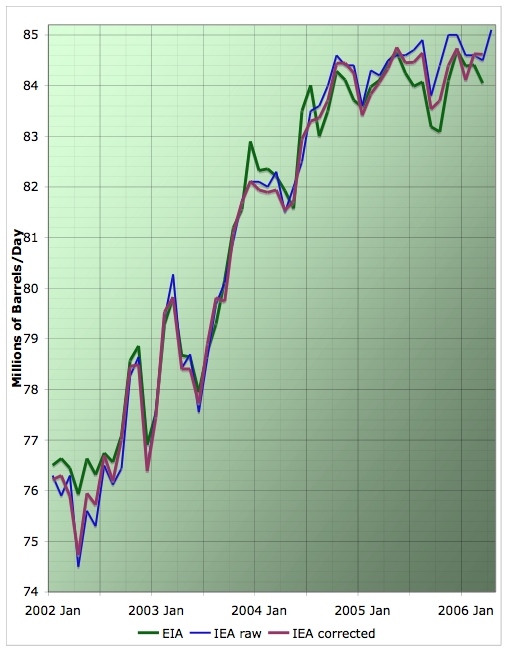
The EIA's International Petroleum Monthly came out on Monday, but I was out of town so didn't get to updating the plateau graphs until tonight (I build them in part out of the EIA's table 1.4, and in part from the IEA's monthly Oil Market Reports). You'll recall that last time the IEA's optimism about March, and even more heady optimism about April, was causing the moving average graph to lean up a little in the plateau.

The EIA is less excited about March - only around 84.0mbpd, down 400kbpd from February. This also casts doubt on the IEA's April figure, I think, but we'll see in a few days.

Average daily oil production, by month, from various estimates. Click to enlarge. Believed to be all liquids. Graph is not zero-scaled. Source: IEA, and EIA. The IEA raw line is what they initially state each month. The IEA corrected line is calculated from the month-on-month production change quoted the following month.

There's more... (338 words) | Comments (12) | Permalink

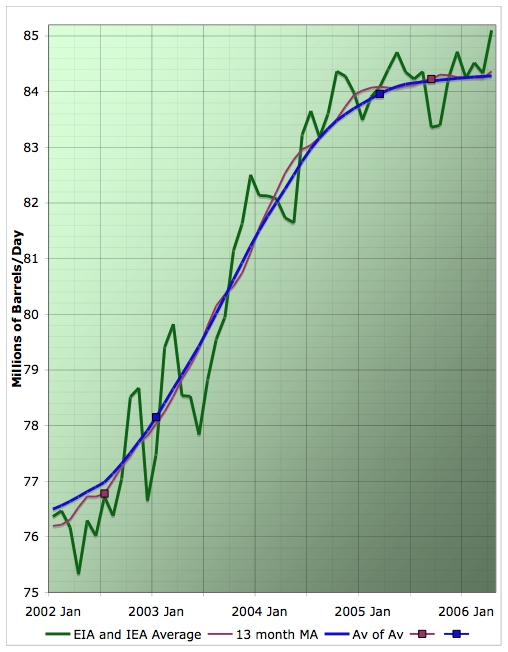
Here's the graph of the average of the two with moving averages. It has flattened a shade in light of the latest data point.

Average daily oil production, by month, averaged from estimates by the EIA and IEA, together with 13 month centered moving average, and recursed moving average of the moving average. The last data point in the monthly data is from the IEA's preliminary estimate alone, and the moving average windows are reduced at the graph edges to only include the data that exists. The squares represent the last point on the correspondingly covered curve where the entire window has full data. Believed to be all liquids. Graph is not zero-scaled. Click to enlarge. Source: IEA, and EIA.

I also draw your attention to this interesting piece at Econbrowser, where Professor Hamilton joins those of us wondering why the Saudi's are claiming they can't find customers so they have to throttle back production when prices have not gone down.

Past coverage relevant to the plateau:

Other relevant coverage:

Τετάρτη, Ιουνίου 07, 2006

Environmental Economics: Tradeable Gas Rights

Environmental Economics: Tradeable Gas Rights: "

Tradeable Gasoline Rights, by Martin Feldstein, Commentary, WSJ: The rapid rise in the price of gasoline has produced calls for tougher fuel economy standards on new cars and trucks. Although reduced gasoline consumption would be good for the environment and for national security, such a regulatory change would be a mistake. A far better approach would be a system of tradeable gasoline rights, or TGRs. These could be distributed in a way that actually raises the income of a majority of households while giving everyone an incentive to reduce gasoline consumption.

In a system of tradeable gasoline rights, the government would give each adult a TGR debit card. The gasoline pumps at service stations ... would be modified to read these new TGR debit cards... Buying a gallon of gasoline would require using up one tradeable gasoline right as well as paying money.

The government would decide how many gallons of gasoline should be consumed per year and would give out that total number of TGRs. In 2006, Americans will buy about 110 billion gallons of gasoline. To keep that total unchanged in 2007, the government would distribute 110 billion TGRs. To reduce total gasoline consumption by 5%, it would cut the number of TGRs to 104.5 billion.

The government could distribute TGRs to reflect geographic differences in driving patterns. ... Businesses that use trucks would also get TGRs.

A key feature of these gasoline rights is that they are tradeable. Individuals with more TGRs than they need could sell the excess, while those who want to use more gallons than their allocation would have to buy extra TGRs. The gasoline companies could act as clearing houses for these trades, using their gasoline pumps to sell TGRs in the same way that they sell gasoline or to buy TGRs in exchange for the cash needed to purchase gasoline. Other institutions like banks could also trade TGRs for cash. And individuals could of course buy and sell TGRs among themselves by letting others use their card.

The market price of a TGR would depend on the number of TGRs that the government distributed relative to the number of gallons that households would buy if there were no TGR system. The smaller the number of TGRs, the greater would be the price per TGR... The money price of gasoline would continue to reflect the world price of oil and the local cost of refining and distribution.

If the price of a TGR turned out to be 50 cents, an individual who buys an extra 20 gallons of gasoline would use up $10 worth of TGRs. If he avoids the purchase -- by driving less, driving at speeds that use less gas, or driving a more fuel-efficient car -- he could sell the 20 TGRs for $10.

The 50 cent price of the TGR would have the same incentive effect as a 50 cent gasoline tax. But while a gasoline tax lowers everyone's real income, the TGR system creates winners as well as losers. Someone who receives 800 TGRs for a year but only needs 500 would pocket $150 by selling his unwanted TGRs. But even such individuals would still face the right incentive: Every extra gallon consumed would reduce their net cash by 50 cents.

Advocates of a gasoline tax argue that it would produce extra revenue that could be used to reduce the budget deficit or to finance equally large cuts in personal taxes. ... [But] it is hard to believe that Congress would now respond to the public's unhappiness over high gasoline prices by enacting a gasoline tax that would raise the price even more.

That aversion to a higher gasoline tax is why tougher mileage standards for new cars is back on the legislative table. They would, however, do virtually nothing to lower the price of gasoline. And if individuals want to economize on gasoline by driving smaller or more fuel-efficient cars, they can do so now without government action. ...

Higher gas mileage standards would reduce gasoline demand in a very inefficient way by focusing exclusively on the rated mileage of new cars. Separate fuel efficiency standards for each type of vehicle -- one of the options now being considered -- would be even worse because it would provide no incentive to switch to more fuel-efficient cars.

Requiring higher mileage standards on new cars would do very little to reduce total gasoline consumption in the near term because each year's new cars are only about 10% of the total cars on the road. Unlike the system of TGRs that raises the effective cost per gallon, the new car standard would do nothing to change the behavior of owners of existing cars. But the TGR system would cause owners to economize on gasoline by driving fewer miles, driving at speeds that use less gasoline, using tires that improve miles per gallon, and servicing their engines to maintain fuel efficiency. And of course the higher effective cost of gasoline would also cause new car buyers to prefer more fuel-efficient vehicles.

In short, a system of tradeable gasoline rights would be better than either higher taxes or tougher new car regulations. That a majority of households could benefit from the TGR system while all households would have an increased incentive to economize on gasoline is both an economic and a political advantage. It would be an efficient way to reduce gasoline that Congress could actually pass.

"

Environmental Economics: Exxon's Valdez settlement

Environmental Economics: Exxon's Valdez settlement: "Just a reminder ($92 Million More ...):

In March 1989, the Exxon Valdez supertanker, with an inebriated captain, ran aground on Bligh Reef, ruptured and spilled 11 million gallons of crude oil into the sound, contaminating about 900 miles of shoreline.

In 1991, the State of Alaska and Exxon reached a $1 billion natural resource damages settlement -- $900 million to be paid out over a number of years and $100 million to be paid this year, maybe, if the cleanup wasn't complete.

Well, the cleanup isn't complete according to the state and, naturally, Exxon disagrees.

'No one doubts there is ongoing damage,' said Eleanor Huffines, of the Alaska office of the Wilderness Society. 'The challenge is that the ocean is so dynamic that it will be a hard thing to do to make the connection. But since this has been the most well-studied area since the spill, they have been able to document the lack of recovery.'

Mark Boudreaux, the media relations manager for Exxon Mobil, focused on this uncertainty in a statement responding to the action. A link between the remaining oil and effects on wildlife, Mr. Boudreaux said, 'is no more than a hypothesis.' He added, 'Nothing we have seen so far, however, indicates that this request for further funding from Exxon is justified.'

The thing about the Exxon settlement that is irritating to economists is that it was NOT a $1 billion settlement ... since it was paid out over a number of years. Consider the $100 million (the state is asking for $92 million) to be paid in 2006, 15 years after the 1991 settlement. With a 3% inflation rate, $100 million in 2006 is the same as $64.2 million in 1991 dollars. Exxon's lament, and Alaska's boast, over the amount of the settlement was bogus.

The thing that is irritating is not that Exxon should be forced to pay $1 billion in real dollars, maybe the nominal payments are about right (although the State of Alaska's funded research found that the damages were $3 billion), but that people who know the difference between real and nominal dollars distort the facts."

Environmental Economics: It's official, green vs green

Environmental Economics: It's official, green vs green: "Continuing the theme, the NYTimes has an article focusing on the internal enviro battles over wind power (Debate over wind ...):

So when it comes to wind, the environmental movement is riven with dissonance and accusations of elitism. Robert F. Kennedy Jr.'s very public opposition to the 130-turbine Cape Wind energy facility proposed off Nantucket Sound has driven a wedge between activists. Dan Boone's circuit riding against wind projects, while not attracting the same celebrity notice, has exasperated many Sierra Club compatriots even more."

Δευτέρα, Μαΐου 29, 2006

Economist's View: Krugman: Nuclear Energy Should Not Be the Main Answer to Our Energy Problems

Economist's View: Krugman: Nuclear Energy Should Not Be the Main Answer to Our Energy Problems: "Krugman: Nuclear Energy Should Not Be the Main Answer to Our Energy Problems

Paul Krugman responds to comments on his latest column and gives sources for his estimates of the cost of policies to offset global warming:

Krugman's Money Talks: Al Gore and the Future of Energy, Commentary, NY Times: Readers respond to Paul Krugman's May 26 column, "A Test of Our Character "

...William R. Mosby, Salt Lake City: Does nuclear energy have a part to play in mitigating global warming in the long term? ... [T]hose who see an urgent need to do something about global warming generally don't talk about nuclear energy as a prominent part of the solution. Do they think that nuclear energy would be a bigger problem than global warming?

Paul Krugman: I was at a reception for Al Gore after a screening of his movie, and he was asked that very question. I thought his answer was very good. He said that yes, nuclear should be part of the mix, but it can't be the main answer. And there are problems with nuclear we need to resolve: not just disposal of radioactive waste, but vulnerability to terrorist attack. In fact, as nuclear power becomes more common around the world, the possible misuse for weapons, terrorist or otherwise, will be a big problem. So unless there are some breakthroughs, nuclear power is only a piece, and maybe not a big one, of the solution.

Mark Neely, Santa Monica, Calif.: ...Is there a way to calculate the profit oil companies make relative to the price of a barrel of crude? ... I ask because it seems to me that all administration energy policies seem to encourage diminishing the availability of crude outside the Arctic Circle and U.S. coastlines at any rate. This only makes sense to me if profitability increases for the oil companies when the price of crude goes up and if, as seems obvious, the administration is facilitating the profitability of oil companies at the expense of the public good.

Paul Krugman: It's not that simple. It depends on what the oil company does. To some extent, oil companies own crude production, and in that case they make more money when the price of crude rises. But a lot of what they do is refining, and the profits on refining depend on the "crack spread" — the difference between the price of a barrel of crude and the price of the gasoline, fuel oil, and other stuff you make from that barrel. Right now both the price of crude and the crack spread are very high, so oil companies are making huge profits.

Michael Papenfus, Milwaukee, Wisc.: ...If you have them available, can you recommend a few citations of serious economic studies exploring the costs of reducing CO2 emissions?

Paul Krugman: Some correspondents have asked for sources on the costs of policies against global warming. It's all pretty technical stuff, but here are two things I looked at. (An awful lot of work goes into things that never make it into the column!) First, in 1998, the Energy Information Agency (a part of the Energy Department) did a survey on the costs of complying with the Kyoto treaty, back before Bush rejected the whole thing. The executive summary is at http://www.eia.doe.gov/oiaf/kyoto/execsum.html. Basically, EIA found that trying to meet the Kyoto target on emissions by 2010 might be fairly expensive, but that meeting the target by 2020 wasn't. The report also compared a number of other estimates: http://www.eia.doe.gov/oiaf/kyoto/cost.html.

Second, William Cline of the Institute for International Economics did a study of climate change policy, which can be found here (pdf), and gives very long-run analyses. I'd focus on Figure 7, on page 21: the costs of an aggressive anti-warming policy eventually reduce Gross World Product by about two percent, compared with what it would otherwise be, but only over a very long period.

Posted by Mark Thoma on May 26,

Economist's View: Paul Krugman: A Test of Our Character

Economist's View: Paul Krugman: A Test of Our Character: "Paul Krugman: A Test of Our Character

Paul Krugman wonders if we are ready for politicians who tell the truth about difficult issues:

A Test of Our Character, by Paul Krugman, Gore's Movie Commentary, NY Times: In his new movie, 'An Inconvenient Truth,' Al Gore suggests that there are three reasons it's hard to get action on global warming. The first is boiled-frog syndrome: because the effects of greenhouse gases build up gradually, at any given moment it's easier to do nothing. The second is the perception, nurtured by a careful disinformation campaign, that there's still a lot of uncertainty about whether man-made global warming is a serious problem. The third is the belief, again fostered by disinformation, that trying to curb global warming would have devastating economic effects.

I'd add a fourth reason... But first, ... Mr. Gore couldn't have asked for a better illustration of disinformation campaigns than the reaction of energy-industry lobbyists and right-wing media organizations to his film. ...

As evidence that global warming isn't really happening, [the National Review] offers the fact that some Antarctic ice sheets are getting thicker ... Curt Davis, ... whose work is cited ... has already protested. ... He points out that an initial increase in the thickness of Antarctica's interior ice sheets is a predicted consequence of a warming planet, so that his results actually support global warming...

[T]hey [also] issue hysterical warnings about the economic consequences of environmentalism. 'Al Gore's global warming movie: could it destroy the economy?' Fox News asked. Well, no, it couldn't. There's ... broad consensus that even a very strong program to reduce emissions would have only modest effects on economic growth. At worst, G.D.P. growth might be, say, one-tenth or two-tenths of a percentage point lower over the next 20 years. ....

But "An Inconvenient Truth" isn't just about global warming... It's also ..., implicitly, a cautionary tale about what's been wrong with our politics.

Why, after all, was Mr. Gore's popular-vote margin in the 2000 election narrow enough that he could be denied the White House? Any account that neglects the determination of some journalists to make him a figure of ridicule misses a key part of the story. Why were those journalists so determined to jeer Mr. Gore? Because of the very qualities that allowed him to realize the importance of global warming, many years before any other major political figure: his earnestness, and his genuine interest in facts, numbers and serious analysis.

And so the 2000 campaign ended up being about the candidates' clothing, their mannerisms, anything but the issues, on which Mr. Gore had a clear advantage...

I won't join the sudden surge of speculation about whether "An Inconvenient Truth" will make Mr. Gore a presidential contender. But the film does make a powerful case that Mr. Gore is the sort of person who ought to be running the country.

Since 2000, we've seen what happens when people who aren't interested in the facts, who believe what they want to believe, sit in the White House. Osama bin Laden is still at large, Iraq is a mess, New Orleans is a wreck. And, of course, we've done nothing about global warming.

But can the sort of person who would act on global warming get elected? Are we — by which I mean both the public and the press — ready for political leaders who don't pander, who are willing to talk about complicated issues and call for responsible policies? That's a test of national character. I wonder whether we'll pass.


"