Παρασκευή, Ιουνίου 23, 2006

The New York Review of Books: The Threat to the Planet

The New York Review of Books: The Threat to the Planet

By Jim Hansen

The Weather Makers: How Man Is Changing the Climate and What It Means for Life on Earth
by Tim Flannery

Atlantic Monthly Press, 357 pp., $24.00

Field Notes from a Catastrophe: Man, Nature, and Climate Change
by Elizabeth Kolbert

Bloomsbury, 210 pp., $22.95

An Inconvenient Truth: The Planetary Emergency of Global Warming and What We Can Do About It
by Al Gore

Melcher Media/Rodale, 325 pp., $21.95 (paper)

An Inconvenient Truth
a film directed by Davis Guggenheim

Jim Hansen is Director of the NASA Goddard Institute for Space Studies and Adjunct Professor of Earth and Environmental Sciences at Columbia University's Earth Institute. His opinions are expressed here, he writes, "as personal views under the protection of the First Amendment of the United States Constitution."

1.

Animals are on the run. Plants are migrating too. The Earth's creatures, save for one species, do not have thermostats in their living rooms that they can adjust for an optimum environment. Animals and plants are adapted to specific climate zones, and they can survive only when they are in those zones. Indeed, scientists often define climate zones by the vegetation and animal life that they support. Gardeners and bird watchers are well aware of this, and their handbooks contain maps of the zones in which a tree or flower can survive and the range of each bird species.

Those maps will have to be redrawn. Most people, mainly aware of larger day-to-day fluctuations in the weather, barely notice that climate, the average weather, is changing. In the 1980s I started to use colored dice that I hoped would help people understand global warming at an early stage. Of the six sides of the dice only two sides were red, or hot, representing the probability of having an unusually warm season during the years between 1951 and 1980. By the first decade of the twenty-first century, four sides were red. Just such an increase in the frequency of unusually warm seasons, in fact, has occurred. But most people —who have other things on their minds and can use thermostats—have taken little notice....

Econbrowser: Oil market predictions

Econbrowser: Oil market predictions: "

Oil market predictions

Cambridge Energy Research Associates seems to be substantially less optimistic than they were a year ago.

CERA received a lot of publicity last summer with their predictions of a coming glut on world oil markets. On June 21, 2005, CERA advised:

[S]upply could exceed demand by as much as 6 to 7.5 million barrels per day (mbd) later in the decade, a marked contrast to the razor-sharp balance between strong demand growth and tight supply that is currently reflected in high oil prices hovering around $60 a barrel....

If demand growth averages a relatively strong 2.2% through 2010, prices could weaken from recent record highs and slip well below $40/bbl as 2007-08 nears. If demand growth were notably weaker, a steeper price fall would be conceivable...

Global oil consumption in fact grew by a more modest 1.6% in 2005, and yet oil prices have risen since CERA made these predictions to a current value near $70 a barrel.

The Oil Drum notes that, with substantially less fanfare, CERA is now offering a much less sanguine assessment of where things are headed. The Oil and Gas Journal reports:

"Incremental additions to refining capacity over the next 2 years [will] be insufficient to meet new global demand," CERA predicts.

For the short term, CERA expects the US industry to use "innovative" methods this summer to overcome logistical hurdles involving the switch to ethanol from methyl tertiary butyl ether (MTBE) in gasoline. More than 10% of gasoline volumes in some areas are affected.

If the US Environmental Protection Agency grants waivers already authorized by the Bush administration for deliveries of nonreformulated gasoline to shortage-prone areas, supplies could be increased through imports as well.

CERA says it also expects US refiners to ramp up to full production as maintenance programs are complete and hurricane-damaged refineries come back on stream.

Nevertheless, such measures may not be enough to lower gasoline prices significantly this summer, CERA says, because of the "continued susceptibility of crude oil prices to geopolitically upward pressure" and because refining capacity additions will lag incremental demand growth, causing global refining tightness. CERA analysts expect global markets to remain tight "with exposure to potentially sharp price upswings-- even in response to small, unexpected disruptions in refinery operations."

Source: Jay Saunders, EIA 2005 Midterm Energy Outlook
sour_production.gif

CERA's new-found pessimism in part recognizes the interaction between refining capabilities and the deteriorating quality of crude that is available to increase global production. On this theme, I have been wondering what accounts for the 400,000 barrel a day drop in Saudi production that apparently occurred in April and May, and came across this explanation from Reuters for at least part of the answer:

China will extend a 50,000 barrel per day (bpd) cut in Saudi crude oil imports into July and August after some refiners struggled to cope with new higher-sulphur supplies, industry officials said.

China contracted to buy 500,000 bpd of Saudi crude in 2006, but cut that back by 10 percent in the second quarter after refiners ill-equipped to handle the kingdom's mainly heavy-sour oil were forced to slow production after running the grades, the officials said.

That is consistent with the conjecture that the 9.5 million barrels per day the Saudis were producing in 2005 can really only be maintained with additional investing in capacity to refine the lower-quality crude they are trying to sell.

Data source: EIA and recent press reports
saudi_prod.gif

It's also consistent with another perspective that I've been advocating for quite a while. Many have articulated a vision of "peak oil" as akin to a cliff that we suddenly wake up to find ourselves to have driven off. I instead envision it as a more gradual process in which we continually pay more for oil, trying to extract lower quality stuff from harder-to-get-at locations and with increasing geopolitical risks. When asked, "what will peak oil look like?", my answer has been, "perhaps a lot like the last two years".

Elsewhere in the news, Green Car Congress noted the release yesterday of the Energy Information Administration's new report on long-term energy prospects. The EIA's benchmark forecast calls for global petroleum consumption to grow by 1.4% per year through 2030.

And where's all that new oil supposed to come from? EIA is counting on Saudi Arabia, for example, to increase its capacity to 14.4 mbd by 2010 and 17.1 mbd by 2030.

I wonder if that's another forecast that we'll see get revised."

Πέμπτη, Ιουνίου 08, 2006

Ανανεώσιμες πηγές VS πετρελαίου

Το παρακάτω άρθρο είναι δημοσιευμένο στην Καθημερινή στις 13-05-06. Ωστόσο είναι πολύ ενδιαφέρον και ιδιαιτέρως ενοχλητικό για την κατάσταση της Ελλάδας.

"Στην κρίση του πετρελαίου, μια σειρά από χώρες απαντούν με συγκεκριμένα μέτρα για την εκμετάλλευση των ανανεώσιμων πηγών. Μην εκπλαγείτε που δεν θα διαβάσετε την Ελλάδα στον κατάλογο. Δυστυχώς, η αναφορά είναι μόνο αρνητική[...] Eίμαστε μια πετρελαιόπληκτη χώρα. Το 73% της συνολικής κατανάλωσης ενέργειας προέρχεται από πετρέλαιο. Η βενζίνη γίνεται είδος πολυτελείας, οι τιμές όλων των προϊόντων ανεβαίνουν λόγω του «μαύρου χρυσού»"

http://www.kathimerini.gr/4dcgi/_w_articles_kathcommon_2_13/05/2006_1285715

The Oil Drum | Discussions about Energy and Our Future

The Oil Drum | Discussions about Energy and Our Future

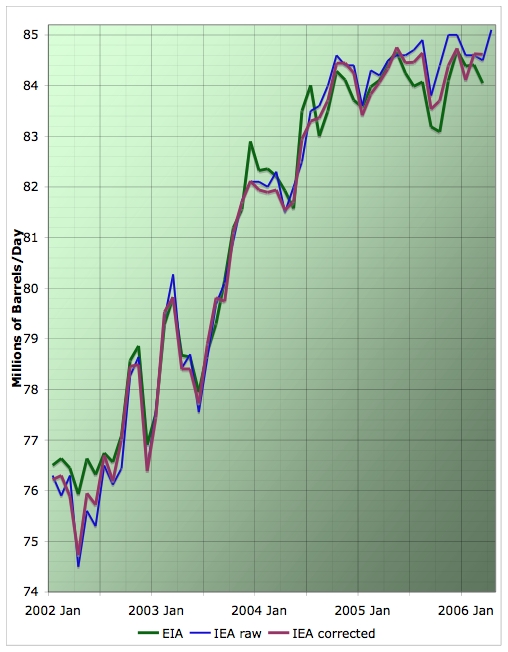
The EIA's International Petroleum Monthly came out on Monday, but I was out of town so didn't get to updating the plateau graphs until tonight (I build them in part out of the EIA's table 1.4, and in part from the IEA's monthly Oil Market Reports). You'll recall that last time the IEA's optimism about March, and even more heady optimism about April, was causing the moving average graph to lean up a little in the plateau.

The EIA is less excited about March - only around 84.0mbpd, down 400kbpd from February. This also casts doubt on the IEA's April figure, I think, but we'll see in a few days.

Average daily oil production, by month, from various estimates. Click to enlarge. Believed to be all liquids. Graph is not zero-scaled. Source: IEA, and EIA. The IEA raw line is what they initially state each month. The IEA corrected line is calculated from the month-on-month production change quoted the following month.

There's more... (338 words) | Comments (12) | Permalink

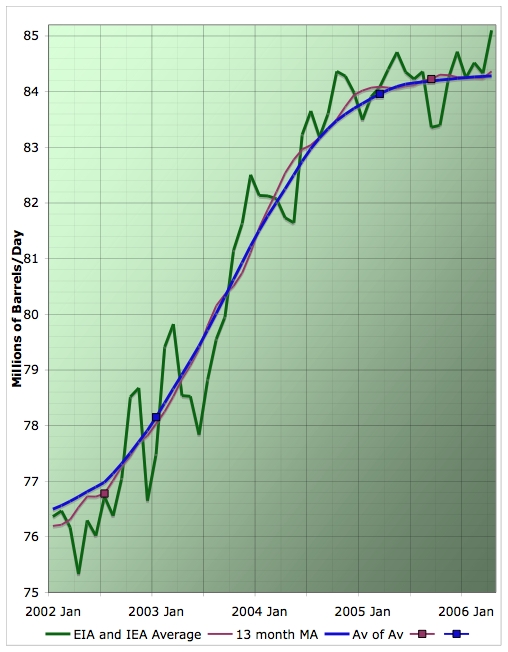
Here's the graph of the average of the two with moving averages. It has flattened a shade in light of the latest data point.

Average daily oil production, by month, averaged from estimates by the EIA and IEA, together with 13 month centered moving average, and recursed moving average of the moving average. The last data point in the monthly data is from the IEA's preliminary estimate alone, and the moving average windows are reduced at the graph edges to only include the data that exists. The squares represent the last point on the correspondingly covered curve where the entire window has full data. Believed to be all liquids. Graph is not zero-scaled. Click to enlarge. Source: IEA, and EIA.

I also draw your attention to this interesting piece at Econbrowser, where Professor Hamilton joins those of us wondering why the Saudi's are claiming they can't find customers so they have to throttle back production when prices have not gone down.

Past coverage relevant to the plateau:

Other relevant coverage:

Τετάρτη, Ιουνίου 07, 2006

Environmental Economics: Tradeable Gas Rights

Environmental Economics: Tradeable Gas Rights: "

Tradeable Gasoline Rights, by Martin Feldstein, Commentary, WSJ: The rapid rise in the price of gasoline has produced calls for tougher fuel economy standards on new cars and trucks. Although reduced gasoline consumption would be good for the environment and for national security, such a regulatory change would be a mistake. A far better approach would be a system of tradeable gasoline rights, or TGRs. These could be distributed in a way that actually raises the income of a majority of households while giving everyone an incentive to reduce gasoline consumption.

In a system of tradeable gasoline rights, the government would give each adult a TGR debit card. The gasoline pumps at service stations ... would be modified to read these new TGR debit cards... Buying a gallon of gasoline would require using up one tradeable gasoline right as well as paying money.

The government would decide how many gallons of gasoline should be consumed per year and would give out that total number of TGRs. In 2006, Americans will buy about 110 billion gallons of gasoline. To keep that total unchanged in 2007, the government would distribute 110 billion TGRs. To reduce total gasoline consumption by 5%, it would cut the number of TGRs to 104.5 billion.

The government could distribute TGRs to reflect geographic differences in driving patterns. ... Businesses that use trucks would also get TGRs.

A key feature of these gasoline rights is that they are tradeable. Individuals with more TGRs than they need could sell the excess, while those who want to use more gallons than their allocation would have to buy extra TGRs. The gasoline companies could act as clearing houses for these trades, using their gasoline pumps to sell TGRs in the same way that they sell gasoline or to buy TGRs in exchange for the cash needed to purchase gasoline. Other institutions like banks could also trade TGRs for cash. And individuals could of course buy and sell TGRs among themselves by letting others use their card.

The market price of a TGR would depend on the number of TGRs that the government distributed relative to the number of gallons that households would buy if there were no TGR system. The smaller the number of TGRs, the greater would be the price per TGR... The money price of gasoline would continue to reflect the world price of oil and the local cost of refining and distribution.

If the price of a TGR turned out to be 50 cents, an individual who buys an extra 20 gallons of gasoline would use up $10 worth of TGRs. If he avoids the purchase -- by driving less, driving at speeds that use less gas, or driving a more fuel-efficient car -- he could sell the 20 TGRs for $10.

The 50 cent price of the TGR would have the same incentive effect as a 50 cent gasoline tax. But while a gasoline tax lowers everyone's real income, the TGR system creates winners as well as losers. Someone who receives 800 TGRs for a year but only needs 500 would pocket $150 by selling his unwanted TGRs. But even such individuals would still face the right incentive: Every extra gallon consumed would reduce their net cash by 50 cents.

Advocates of a gasoline tax argue that it would produce extra revenue that could be used to reduce the budget deficit or to finance equally large cuts in personal taxes. ... [But] it is hard to believe that Congress would now respond to the public's unhappiness over high gasoline prices by enacting a gasoline tax that would raise the price even more.

That aversion to a higher gasoline tax is why tougher mileage standards for new cars is back on the legislative table. They would, however, do virtually nothing to lower the price of gasoline. And if individuals want to economize on gasoline by driving smaller or more fuel-efficient cars, they can do so now without government action. ...

Higher gas mileage standards would reduce gasoline demand in a very inefficient way by focusing exclusively on the rated mileage of new cars. Separate fuel efficiency standards for each type of vehicle -- one of the options now being considered -- would be even worse because it would provide no incentive to switch to more fuel-efficient cars.

Requiring higher mileage standards on new cars would do very little to reduce total gasoline consumption in the near term because each year's new cars are only about 10% of the total cars on the road. Unlike the system of TGRs that raises the effective cost per gallon, the new car standard would do nothing to change the behavior of owners of existing cars. But the TGR system would cause owners to economize on gasoline by driving fewer miles, driving at speeds that use less gasoline, using tires that improve miles per gallon, and servicing their engines to maintain fuel efficiency. And of course the higher effective cost of gasoline would also cause new car buyers to prefer more fuel-efficient vehicles.

In short, a system of tradeable gasoline rights would be better than either higher taxes or tougher new car regulations. That a majority of households could benefit from the TGR system while all households would have an increased incentive to economize on gasoline is both an economic and a political advantage. It would be an efficient way to reduce gasoline that Congress could actually pass.

"

Environmental Economics: Exxon's Valdez settlement

Environmental Economics: Exxon's Valdez settlement: "Just a reminder ($92 Million More ...):

In March 1989, the Exxon Valdez supertanker, with an inebriated captain, ran aground on Bligh Reef, ruptured and spilled 11 million gallons of crude oil into the sound, contaminating about 900 miles of shoreline.

In 1991, the State of Alaska and Exxon reached a $1 billion natural resource damages settlement -- $900 million to be paid out over a number of years and $100 million to be paid this year, maybe, if the cleanup wasn't complete.

Well, the cleanup isn't complete according to the state and, naturally, Exxon disagrees.

'No one doubts there is ongoing damage,' said Eleanor Huffines, of the Alaska office of the Wilderness Society. 'The challenge is that the ocean is so dynamic that it will be a hard thing to do to make the connection. But since this has been the most well-studied area since the spill, they have been able to document the lack of recovery.'

Mark Boudreaux, the media relations manager for Exxon Mobil, focused on this uncertainty in a statement responding to the action. A link between the remaining oil and effects on wildlife, Mr. Boudreaux said, 'is no more than a hypothesis.' He added, 'Nothing we have seen so far, however, indicates that this request for further funding from Exxon is justified.'

The thing about the Exxon settlement that is irritating to economists is that it was NOT a $1 billion settlement ... since it was paid out over a number of years. Consider the $100 million (the state is asking for $92 million) to be paid in 2006, 15 years after the 1991 settlement. With a 3% inflation rate, $100 million in 2006 is the same as $64.2 million in 1991 dollars. Exxon's lament, and Alaska's boast, over the amount of the settlement was bogus.

The thing that is irritating is not that Exxon should be forced to pay $1 billion in real dollars, maybe the nominal payments are about right (although the State of Alaska's funded research found that the damages were $3 billion), but that people who know the difference between real and nominal dollars distort the facts."

Environmental Economics: It's official, green vs green

Environmental Economics: It's official, green vs green: "Continuing the theme, the NYTimes has an article focusing on the internal enviro battles over wind power (Debate over wind ...):

So when it comes to wind, the environmental movement is riven with dissonance and accusations of elitism. Robert F. Kennedy Jr.'s very public opposition to the 130-turbine Cape Wind energy facility proposed off Nantucket Sound has driven a wedge between activists. Dan Boone's circuit riding against wind projects, while not attracting the same celebrity notice, has exasperated many Sierra Club compatriots even more."

Δευτέρα, Μαΐου 29, 2006

Economist's View: Krugman: Nuclear Energy Should Not Be the Main Answer to Our Energy Problems

Economist's View: Krugman: Nuclear Energy Should Not Be the Main Answer to Our Energy Problems: "Krugman: Nuclear Energy Should Not Be the Main Answer to Our Energy Problems

Paul Krugman responds to comments on his latest column and gives sources for his estimates of the cost of policies to offset global warming:

Krugman's Money Talks: Al Gore and the Future of Energy, Commentary, NY Times: Readers respond to Paul Krugman's May 26 column, "A Test of Our Character "

...William R. Mosby, Salt Lake City: Does nuclear energy have a part to play in mitigating global warming in the long term? ... [T]hose who see an urgent need to do something about global warming generally don't talk about nuclear energy as a prominent part of the solution. Do they think that nuclear energy would be a bigger problem than global warming?

Paul Krugman: I was at a reception for Al Gore after a screening of his movie, and he was asked that very question. I thought his answer was very good. He said that yes, nuclear should be part of the mix, but it can't be the main answer. And there are problems with nuclear we need to resolve: not just disposal of radioactive waste, but vulnerability to terrorist attack. In fact, as nuclear power becomes more common around the world, the possible misuse for weapons, terrorist or otherwise, will be a big problem. So unless there are some breakthroughs, nuclear power is only a piece, and maybe not a big one, of the solution.

Mark Neely, Santa Monica, Calif.: ...Is there a way to calculate the profit oil companies make relative to the price of a barrel of crude? ... I ask because it seems to me that all administration energy policies seem to encourage diminishing the availability of crude outside the Arctic Circle and U.S. coastlines at any rate. This only makes sense to me if profitability increases for the oil companies when the price of crude goes up and if, as seems obvious, the administration is facilitating the profitability of oil companies at the expense of the public good.

Paul Krugman: It's not that simple. It depends on what the oil company does. To some extent, oil companies own crude production, and in that case they make more money when the price of crude rises. But a lot of what they do is refining, and the profits on refining depend on the "crack spread" — the difference between the price of a barrel of crude and the price of the gasoline, fuel oil, and other stuff you make from that barrel. Right now both the price of crude and the crack spread are very high, so oil companies are making huge profits.

Michael Papenfus, Milwaukee, Wisc.: ...If you have them available, can you recommend a few citations of serious economic studies exploring the costs of reducing CO2 emissions?

Paul Krugman: Some correspondents have asked for sources on the costs of policies against global warming. It's all pretty technical stuff, but here are two things I looked at. (An awful lot of work goes into things that never make it into the column!) First, in 1998, the Energy Information Agency (a part of the Energy Department) did a survey on the costs of complying with the Kyoto treaty, back before Bush rejected the whole thing. The executive summary is at http://www.eia.doe.gov/oiaf/kyoto/execsum.html. Basically, EIA found that trying to meet the Kyoto target on emissions by 2010 might be fairly expensive, but that meeting the target by 2020 wasn't. The report also compared a number of other estimates: http://www.eia.doe.gov/oiaf/kyoto/cost.html.

Second, William Cline of the Institute for International Economics did a study of climate change policy, which can be found here (pdf), and gives very long-run analyses. I'd focus on Figure 7, on page 21: the costs of an aggressive anti-warming policy eventually reduce Gross World Product by about two percent, compared with what it would otherwise be, but only over a very long period.

Posted by Mark Thoma on May 26,

Economist's View: Paul Krugman: A Test of Our Character

Economist's View: Paul Krugman: A Test of Our Character: "Paul Krugman: A Test of Our Character

Paul Krugman wonders if we are ready for politicians who tell the truth about difficult issues:

A Test of Our Character, by Paul Krugman, Gore's Movie Commentary, NY Times: In his new movie, 'An Inconvenient Truth,' Al Gore suggests that there are three reasons it's hard to get action on global warming. The first is boiled-frog syndrome: because the effects of greenhouse gases build up gradually, at any given moment it's easier to do nothing. The second is the perception, nurtured by a careful disinformation campaign, that there's still a lot of uncertainty about whether man-made global warming is a serious problem. The third is the belief, again fostered by disinformation, that trying to curb global warming would have devastating economic effects.

I'd add a fourth reason... But first, ... Mr. Gore couldn't have asked for a better illustration of disinformation campaigns than the reaction of energy-industry lobbyists and right-wing media organizations to his film. ...

As evidence that global warming isn't really happening, [the National Review] offers the fact that some Antarctic ice sheets are getting thicker ... Curt Davis, ... whose work is cited ... has already protested. ... He points out that an initial increase in the thickness of Antarctica's interior ice sheets is a predicted consequence of a warming planet, so that his results actually support global warming...

[T]hey [also] issue hysterical warnings about the economic consequences of environmentalism. 'Al Gore's global warming movie: could it destroy the economy?' Fox News asked. Well, no, it couldn't. There's ... broad consensus that even a very strong program to reduce emissions would have only modest effects on economic growth. At worst, G.D.P. growth might be, say, one-tenth or two-tenths of a percentage point lower over the next 20 years. ....

But "An Inconvenient Truth" isn't just about global warming... It's also ..., implicitly, a cautionary tale about what's been wrong with our politics.

Why, after all, was Mr. Gore's popular-vote margin in the 2000 election narrow enough that he could be denied the White House? Any account that neglects the determination of some journalists to make him a figure of ridicule misses a key part of the story. Why were those journalists so determined to jeer Mr. Gore? Because of the very qualities that allowed him to realize the importance of global warming, many years before any other major political figure: his earnestness, and his genuine interest in facts, numbers and serious analysis.

And so the 2000 campaign ended up being about the candidates' clothing, their mannerisms, anything but the issues, on which Mr. Gore had a clear advantage...

I won't join the sudden surge of speculation about whether "An Inconvenient Truth" will make Mr. Gore a presidential contender. But the film does make a powerful case that Mr. Gore is the sort of person who ought to be running the country.

Since 2000, we've seen what happens when people who aren't interested in the facts, who believe what they want to believe, sit in the White House. Osama bin Laden is still at large, Iraq is a mess, New Orleans is a wreck. And, of course, we've done nothing about global warming.

But can the sort of person who would act on global warming get elected? Are we — by which I mean both the public and the press — ready for political leaders who don't pander, who are willing to talk about complicated issues and call for responsible policies? That's a test of national character. I wonder whether we'll pass.


"

Economist's View: Paul Krugman: Swift Boating the Planet

Economist's View: Paul Krugman: Swift Boating the Planet

In response to a recent post about John Kerry and the Swift Boat crowd, many of you called for Democrats to get tougher. Paul Krugman agrees:

Swift Boating the Planet, by Paul Krugman, Climate Lies Commentary, NY Times: A brief segment in "An Inconvenient Truth" shows Senator Al Gore questioning James Hansen, a climatologist at NASA, during a 1989 hearing. But the movie doesn't ... tell you what happened to Dr. Hansen later.

And that's a story worth telling, for two reasons. It's a good illustration of the way interest groups can create the appearance of doubt even when the facts are clear and cloud the reputations of people who should be regarded as heroes. And it's a warning for Mr. Gore and others...: you're going to have to get tougher, because the other side doesn't play by any known rules.

Dr. Hansen was one of the first climate scientists to say publicly that global warming was underway. In 1988, he made headlines with Senate testimony in which he declared that "the greenhouse effect has been detected, and it is changing our climate now."...

By rights, Dr. Hansen should have been universally acclaimed... But soon after Dr. Hansen's 1988 testimony, energy companies began a campaign to create doubt about global warming... And in the late 1990's, climate skeptics began a smear campaign against Dr. Hansen himself.

Leading the charge was Patrick Michaels, a professor at the University of Virginia who has received substantial financial support from the energy industry. In Senate testimony, and then in numerous presentations, Dr. Michaels claimed that the actual pace of global warming was falling far short of Dr. Hansen's predictions. As evidence, he presented a chart supposedly taken from a 1988 paper written by Dr. Hansen and others, which showed a curve of rising temperatures considerably steeper than the trend that has actually taken place.

In fact, the chart Dr. Michaels showed was a fraud... The original paper showed a range of possibilities, and the actual rise in temperature has fallen squarely in the middle of that range. So how did Dr. Michaels make it seem as if Dr. Hansen's prediction was wildly off? Why, he erased all the lower curves, leaving only the curve that the original paper described as being "on the high side of reality." ...

Dr. Hansen has been trying to correct the record for years. Yet the claim ... has remained in circulation, and has become a staple of climate change skeptics, from Michael Crichton to Robert Novak. There's a concise way to describe what happened to Dr. Hansen: he was Swift-boated.

John Kerry, a genuine war hero, didn't realize that he could successfully be portrayed as a coward. And it seems to me that Dr. Hansen ... didn't believe that he could successfully be portrayed as an unreliable exaggerator. His first response to Dr. Michaels, in January 1999, was astonishingly diffident. ... rather than denouncing the fraud involved, he offered a rather plaintive appeal for better behavior.

Even now, Dr. Hansen seems reluctant to say the obvious. "Is this treading close to scientific fraud?" he recently asked about Dr. Michaels' smear. The answer is no: it isn't "treading close," it's fraud pure and simple.

Now, Dr. Hansen isn't running for office. But Mr. Gore might be, and even if he isn't, he hopes to promote global warming as a political issue. And if he wants to do that, he and those on his side will have to learn to call liars what they are.

Πέμπτη, Μαΐου 25, 2006

Econbrowser: Energy futures as predictors

Econbrowser: Energy futures as predictors: "Energy futures as predictors

Energy futures as predictors

Many publications use energy futures as proxy measures for market expectations of future energy prices. Does this procedure make sense?

Consider the IMF's recent World Economic Outlook, which included a figure with futures a year ago, and in March. While futures a year ago indicated some decline, the most recent reading indicate persistently high prices.

weooilfut.jpg
Figure 1.20 from IMF WEO, April 2006.

A relevant question is whether futures are actually good predictors of future spot oil prices. The answer is not obvious -- for instance, for currencies futures aren't good predictors. In a paper assessing energy futures, coauthored with Olivier Coibion and Michael LeBlanc, I assessed whether the gap between the futures rate and current spot rate predicts the actual change in the spot oil price. Over the 1990-2004 period, we find that at 3 month, 6 month and one year horizons, regression of actual change on predicted yields coefficients of 1.2, 0.8 and 0.9, respectively. In no case can the null hypothesis of unbiasedness be rejected.

Econbrowser: Natural gas and crude oil prices

Econbrowser: Natural gas and crude oil prices

Natural gas and crude oil prices

Can natural gas fall this far without oil prices moving more?

A barrel of oil has about six times the energy content of a thousand cubic feet of natural gas. Although they're far from perfect substitutes, some firms can switch between oil and natural gas depending on price and availability. Longer term, consumers or firms making a fixed commitment to oil or natural gas will of course look at the relative prices. Thus one's first guess might be that, over the long run, a barrel of oil should sell for something around six times the price of a thousand cubic feet of natural gas.

The graph below shows that this has been a pretty fair description over the past six years. Up until the last few months, that is, which have left natural gas selling for about half its value from December, while oil is little changed.


nat_gas_crude_price.gif

If the historical correlation holds up, something's got to give here. Strikes me as another reason to wonder about oil above $70 a barrel.

Δευτέρα, Μαΐου 22, 2006

Case Closed: The Debate about Global Warming is Over

The Brookings Institution, May 17, 2006

Gregg Easterbrook, Visiting Fellow, Governance Studies


print
email
feedback


Gregg Easterbrook
Gregg Easterbrook

Executive Summary

Here's the short version of everything you need to know about global warming. First, the consensus of the scientific community has shifted from skepticism to near-unanimous acceptance of the evidence of an artificial greenhouse effect. Second, while artificial climate change may have some beneficial effects, the odds are we're not going to like it. Third, reducing emissions of greenhouse gases may turn out to be much more practical and affordable than currently assumed.

This briefing will address the three points above and, in an appendix, offer non-jargon explanations of the most important recent findings of greenhouse science. But the pressing point of this briefing is not so much scientific as it is practical—that action against artificial global warming may not prove nearly as expensive or daunting as commonly believed. Greenhouse gases are an air pollution problem, and all air pollution problems of the past have cost significantly less to fix than projected, while declining faster than expected. This gives cause to hope that artificial greenhouse gases can be controlled reasonably cheaply and without wrenching sacrifices to the global economy. And if there is a chance of an economical approach to greenhouse-gas reduction, then what are we waiting for? Let's start now.

View Full Paper(PDF—163kb)


Note: The views expressed in this piece are those of the author and

Case Closed: The Debate about Global Warming is Over

Case Closed: The Debate about Global Warming is Over

The Brookings Institution, May 17, 2006

Gregg Easterbrook, Visiting Fellow, Governance Studies

View Full Paper (PDF—163kb). Get Adobe Acrobat Reader

print
email
feedback


Gregg Easterbrook
Gregg Easterbrook

Executive Summary

Here's the short version of everything you need to know about global warming. First, the consensus of the scientific community has shifted from skepticism to near-unanimous acceptance of the evidence of an artificial greenhouse effect. Second, while artificial climate change may have some beneficial effects, the odds are we're not going to like it. Third, reducing emissions of greenhouse gases may turn out to be much more practical and affordable than currently assumed.

This briefing will address the three points above and, in an appendix, offer non-jargon explanations of the most important recent findings of greenhouse science. But the pressing point of this briefing is not so much scientific as it is practical—that action against artificial global warming may not prove nearly as expensive or daunting as commonly believed. Greenhouse gases are an air pollution problem, and all air pollution problems of the past have cost significantly less to fix than projected, while declining faster than expected. This gives cause to hope that artificial greenhouse gases can be controlled reasonably cheaply and without wrenching sacrifices to the global economy. And if there is a chance of an economical approach to greenhouse-gas reduction, then what are we waiting for? Let's start now.

View Full Paper(PDF—163kb)

Τρίτη, Μαΐου 16, 2006

Nuclear power will drive the future - Editorials & Commentary - International Herald Tribune

Nuclear power will drive the future - Editorials & Commentary - International Herald Tribune

From the minute the alarm clock goes off in the morning, our lives are fueled by electricity. We are amazed at the seemingly endless parade of new, life-improving and life-saving technologies. But too little attention is paid to the looming shortage of energy needed to power them. We take for granted that the lights will come on at the flip of a switch.
The Department of Energy projects that the United States will need 45 percent more electricity by 2030. Where is this going to come from? Energy conservation, greater efficiencies in the production of natural gas, oil, coal and hydro power, and a genuine commitment to renewables such as wind, solar, and geothermal power will be needed.
Across America today, companies are reducing their demands for power without slowing their growth, but those efforts won't be enough in and of themselves. We will continue to need a mix of power sources, and nuclear energy must play an increased role in supplying America's growing demand for electricity.
Nuclear energy offers numerous benefits and advantages over other sources.
It's cleaner. Nuclear energy has the lowest impact on the environment - air, land, water and wildlife - of any major energy source. It produces no harmful greenhouse gases or controlled air pollutants, its waste byproducts are isolated from the environment, and it requires less land to produce the same amount of electricity as other electricity sources....

Europe set bar low on greenhouse gas targets - Business - International Herald Tribune

Europe set bar low on greenhouse gas targets - Business - International Herald Tribune

The European Commission admitted Monday that member states had given companies far too generous targets for greenhouse gas emissions last year, raising questions about the Continent's ability to meet its obligations under the Kyoto Protocol and triggering chaos in Europe's embryonic market in trading emissions credits.
The revelations, some of which had been leaked earlier in the month, prompted Germany and Britain to call for stricter European quotas for greenhouse gas emissions in the years ahead.
Although companies polluted less than expected, the move by Germany and Britain indicated that the level of Europe's carbon dioxide emissions was still too high to meet the goals set out by the Kyoto agreement among countries to fight global warming.
Europe's market to trade carbon dioxide credits was shaken Friday when the news was leaked in a posting on the commission's Web site. Governments use the market, which opened in January 2005, to curb industrial pollution by allocating permits limiting the amount of carbon dioxide countries can release into the atmosphere. Companies can trade the permits, selling credits they do not need or buying extra ones if they exceed their quotas. On Monday, Germany said it would cut the number of credits it had handed out, a controversial move that is being opposed in court by the European Union.
Europe's market for trading these credits was worth $10 billion in 2005, and may grow to as much as $30 billion in 2006, the World Bank estimates. Its success, analysts say, is crucial to reaching the Kyoto Protocol goals. "Trading is the only way to reduce emissions economically and efficiently," said Louis Redshaw, head of environmental products at Barclays Capital.
In recent weeks, though, the market has attracted calls for a swift overhaul from participants, environmentalists and governments alike. At the heart of the complaints: Information that filtered out to the market beginning with the Netherlands on April 25 showed that countries had far lower carbon emissions than the market had budgeted for. The European Commission's official figures, released Monday, showed that 21 of the 25 member states produced 44.1 million tons less carbon dioxide, or 2.5 percent less, in 2005 than expected.
Taken at face value, this should be good news: After all, lowering carbon dioxide is the goal. But many in the market say the reverse is true: Governments, under pressure from industry, have overestimated the amount of carbon dioxide credits their companies need, making it possible for companies to sell them at a profit.
So far, the permit market appears to have done more for the balance sheets of power companies than for pollution control. The permits, which started trading at about €9, or $11, in January 2005, peaked at €30 last month and have raised the revenues of power companies in the EU 15 percent to 25 percent, according to Point Carbon, a consulting firm specializing in energy markets and emissions trading based in Oslo.
"The electricity sector has had a very good year," said Kristian Tanger, research director at Point Carbon, adding that most improvements in energy efficiency in the past year were unrelated to the trading system.
If several countries emitted fewer gases than expected it was because governments had handed out 1 percent to 4 percent more permits than industry had required, Tanger said. One explanation is that the emissions market is unique in terms of the sway governments hold over it. They determine how much their countries get to pollute and which industries get how many permits.
So the fact that European countries have hit, or even come in under, their targets is by no means an indication that they will meet the obligations for emission cuts set in the Kyoto Protocol, he said. "Most countries are off track when it comes to Kyoto," Tanger said.
Environmental activists and agencies argue that the recently released year-end figures show that most European governments are more interested in protecting their companies than in reducing carbon emissions. "Governments have been cheated by the big industries, which gave them the wrong assumptions for their emissions," said Stephen Singer, head of the European climate and energy policy unit of the World Wildlife Fund.
Fran?ois Loos, France's industry minister, disputed this, but said that he and his counterparts from Germany, Belgium, the Netherlands and Luxembourg were working on a proposal for the commission that would avoid carbon prices driving electricity prices - and profits of power companies - higher. The proposal will be submitted in June, he said.
Meanwhile, the banks, brokers, hedge funds and traders that jumped into the rapidly growing market for trading carbon emission credits complain that the big difference between what countries estimated they would use and what they actually used unfairly skews the market.

Κυριακή, Μαΐου 14, 2006

First fry, then drive!

Is it possible to fry your potatoes and then fill up your reservoir and go for a newspaper? In fact not so easily yet. I have heard some things about bio-fuels but never had the chance to read a relevant detailed article. Today, at "Βήμα" I read an article that described what are bio-fuels and what is the current situation in Greece and the rest of the world. I found it quite interesting and worths a look (it is in greek...)

Link: http://tovima.dolnet.gr/print_article.php?e=B&f=14761&m=D14&aa=1

Τετάρτη, Μαΐου 10, 2006

Economic Growth and the Environment

During the last semester I prepared an assignment focused on the connection between economic growth and the environment. Specifically, I attempted to make a short survey on the existing literature of the Environmental Kuznets Curve (EKC) Hypothesis. I must admit that I did not expect to find the field so interesting. Nevertheless, not only I finished the assignment, but also decided to devote my Master thesis on this field.

So all through the last months I am browsing in various journals in order to find articles upon this subject. Completely by luck I found a Literature Survey of Panayotou T. (2000), which I think that consists the most concise survey I have yet found for the EKC hypothesis. In fact one cannot find many surveys on EKCs (Dinda, Borghesi, etc.).

Panayotou's survey lacks though in the analysis of the macro-theoretical connection of economic growth and environment. For such analysis, one might better turn to more seminal papers of the field. In any case, the paper was a revelation for me. For this exact reason I decided to post a link to it.

Link: http://www2.cid.harvard.edu/cidwp/056.pdf

(Tip: Great Appendix!!!!)

Τρίτη, Μαΐου 09, 2006

The Oil Drum | Discussions about Energy and Our Future

The Oil Drum | Discussions about Energy and Our Future

Ah! Do we really need six pages of comment? Thank you at the back, we'll gladly cut it short. Suffice it to say I had the chance to split part of a bottle of wine with Ken Deffeyes (we talked a little about Abu Sa'fah the first indication of Saudi depletion, since the combined 800 kbd from it and Qatif were designated purely to match declines in existing fields at the time they came on stream.) There were a couple of short chats with Governor Schweitzer of Montana about 5-micron coal and a recognition, as the talks went on through the afternoon, that maybe the ground is changing. But first an admission - they caught me out. Since Dr James Hansen had to be recognized as one of the Time 100 Folk of the Year, later this afternoon, they moved his talk up, and so sadly I missed the first bit. So this is where I put in another plug for the web site (URL corrected here and earlier), to get the Powerpoints. His message, as I caught it, was largely that we can only afford to raise the temperature of the planet one single degree Centigrade, and beyond that the historic record suggests catastrophe. One part of this is the melting of the polar ice caps, and, in this regard he showed the melt pictures and the latest measurements of the weight of Greenland (from one of the satellites). What is interesting in that, is that the last couple of years seemed to have created more of a trend out of the data. He commented (perhaps in response to Dr Crichton) that this may provided more reliable data than models. ...

The Limits of Biofuels

The Limits of Biofuels

[editor's note, by Stuart Staniford] With this post, we welcome Kyle as a contributor to the blog. You may recall his excellent guest post on the potential of cellulosic ethanol.

One question that always arises with biofuels is "How much can we really produce?" For most fuels, this depends upon the feedstock, i.e., corn versus cellulose for ethanol. However, there are definite limits, and as time progresses, my guess is that we will see more and more proposals like the one below the fold:

There's more... (428 words) | Comments (19) | Permalink | Trackback: Google Technorati

Dynoil to Build 1.5 bgy Biodiesel Refinery in Houston

To help lessen the U.S. dependency on foreign oil, Dynoil's commitment to producing an alternative diesel fuel is under way with its plan to build a 1.5 billion gallon per year (bgy) refinery that will process vegetable oil feedstock into environmentally friendly biodiesel. The intention was announced by A. Vernon Wright, Chief Executive Officer of Dynoil LLC, a Delaware Limited Liability Company.

The company concluded from its market studies that the current market for biodiesel in the U.S. Gulf Coast is at least 100,000 barrels per day, and it identified markets on the U.S. East, West Coasts and on the Great Lakes where it intends to expand its production of biodiesel. A site for the refinery has been selected near Houston, Texas, and the U.S. Gulf Coast. The plant will process conventional vegetable oil into biodiesel fuel that will contain zero sulphur and nearly zero nitrogen oxide (NOx) emissions. Dynoil's biodiesel can be blended into various grades of diesel fuel that can contain anywhere from five percent (B5) to 20 percent (B20) biodiesel to meet market demand requirements.

The refinery will process approximately 100,000 barrels per day of vegetable oil into fuel that can be used as a blending stock with petroleum diesel. The company plans to use state-of-the-art technology to convert vegetable oil into consumable fuel oil. Biodiesel can also be used for home heating or electric power generation.

The company concluded from its market studies that the current market for biodiesel in the U.S. Gulf Coast is at least 100,000 barrels per day, and it identified markets on the U.S. East and West Coasts and on the Great Lakes where Dynoil will expand biodiesel production.

In normal business speak, there clearly is a market for that much biodiesel, so full speed ahead! However, the detail that is missing is that the entire US production of soybean oil (the main kind produced here, as our climate is too cold for palm oil and too warm for rapeseed) is 2.5 billion gallons per year. In other words, this single "bio-refinery" will consume roughly 60% of the soybean oil produced annually in the US! It seems that at some point we may need a "third party" to keep ourselves from burning all of our food just to keep those vehicles on the road...

Just for reference, world production of all vegatable oils is about 600 million barrels annually (1.65 million barrels/day), about 1 weeks worth of oil usage.