How well was the European Union carbon-emission permit system designed and who has benefited the most? The Economist looks into this question and concludes that a poorly designed system has allowed power companies rather than the environment to be the the main beneficiaries:
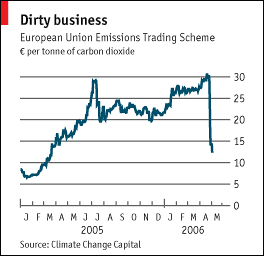
Cleaning up, The Economist: Markets are naturally volatile; but when they are new, thin and involve governments, they are especially capricious. So it is with the market for carbon-emission permits created by the establishment of the European Union Emissions Trading Scheme (ETS) in January 2005. The price of permits, which had tripled since the scheme's launch, dropped by more than half in the last week of April.
The ETS is designed to cut greenhouse-gas emissions so that European countries meet the targets set for them by the Kyoto climate-change agreement. Some 13,000 factories and power stations in five different industries may emit carbon only if they have a permit. At the start of the scheme, they were given permits worth around 2.2 billion tonnes of carbon dioxide per year. Those permits may be used up as fuel is burned and carbon generated, or they may be traded. Around €10 billion-worth ($12.4 billion-worth) of permits were traded last year. This year the figure will probably be three times that.
When the scheme was originally established, politicians expected the permit price to hover around €10 a tonne. Instead, it rose to a peak of €30. “The gas-coal spread is mostly responsible,” explains Anthony White of Climate Change Capital... The power-generation business dominates the carbon market, because it emits so much pollution. In Europe, gas and coal are the main fuels used. When the gas price rises, power companies tend to switch to coal. Coal is dirtier than gas; so, as power companies switch to coal, they need more permits, and the price rises.
Then, in late April, several countries, including France and Spain, announced how much carbon they had emitted last year. The numbers were surprisingly small. Suddenly, the future demand for permits looked lower than expected—and the price crashed. Unfortunately, the numbers reflect not the scheme's success in cutting pollution, but industry's success in getting itself allocated more permits than actual emissions warranted when the scheme was launched. ...
So far, the ETS has done more for power-generating companies than it has for curbing pollution. Because carbon permits were handed out free, rather than auctioned (as most economists said they should be); and because the carbon price has been unexpectedly high, permit-holders found they were sitting on unexpectedly valuable property rights. IPA Energy Consulting, in a report for the British government on the scheme, says it reckons that the British power-generation sector has profited to the tune of £800m ($1.5 billion) a year.
Meanwhile, there's no sign that the permit regime has brought about a switch to cleaner fuel—indeed, the reverse has been happening. That's not just because gas has been so much more expensive than coal, but also because the first phase of the ETS lasts only three years. Beyond that, nobody has any idea how many permits will be issued, and therefore what the price might be. And since investments to reduce emissions have pay-back periods of five or more years, nobody is going to start investing on a three-year view.
The ETS's troubles do not mean markets are no use in curbing emissions—but they do mean that markets need to be part of a scheme that has been well designed. The ETS hasn't.
Surprise, the utilities overstated their emissions right before regulation. This is like understating your income on your tax return. The real surprise that really isn't a surprise is that the utilities got away with it.
So, what is the solution here? I'm thinking the EU needs to sell a reduced number of permits each year until they hit their carbon target. Plus, extend the regulatory time period to decrease the uncertainty about the future value of permits.
Am I missing anything?
The Economist recently ran a story airing Peak Oil concerns from "pessimists" and counters from "optimists." NPR ran a similar spot May 2.
FINANCE & ECONOMICS
The oil industry
Steady as she goes [$]
Apr 20th 2006 | BAKERSFIELD, CALIFORNIA, AND CALGARY, ALBERTA
From The Economist print edition
Why the world is not about to run out of oil
…For years a small group of geologists has been claiming that the world has started to grow short of oil, that alternatives cannot possibly replace it and that an imminent peak in production will lead to economic disaster. In recent months this view has gained wider acceptance on Wall Street and in the media. Recent books on oil have bewailed the threat. Every few weeks, it seems, “Out of Gas”, “The Empty Tank” and “The Coming Economic Collapse: How You Can Thrive When Oil Costs $200 a Barrel”, are joined by yet more gloomy titles. Oil companies, which once dismissed the depletion argument out of hand, are now part of the debate. Chevron's splashy advertisements strike an ominous tone: “It took us 125 years to use the first trillion barrels of oil. We'll use the next trillion in 30.” Jeroen van der Veer, chief executive of Royal Dutch Shell, believes “the debate has changed in the last two years from 'Can we afford oil?' to 'Is the oil there?'”But is the world really starting to run out of oil? And would hitting a global peak of production necessarily spell economic ruin? Both questions are arguable. Despite today's obsession with the idea of “peak oil”, what really matters to the world economy is not when conventional oil production peaks, but whether we have enough affordable and convenient fuel from any source to power our current fleet of cars, buses and aeroplanes. With that in mind, the global oil industry is on the verge of a dramatic transformation from a risky exploration business into a technology-intensive manufacturing business. And the product that big oil companies will soon be manufacturing, argues Shell's Mr Van der Veer, is “greener fossil fuels”.
The race is on to manufacture such fuels for blending into petrol and diesel today, thus extending the useful life of the world's remaining oil reserves. This shift in emphasis from discovery to manufacturing opens the door to firms outside the oil industry (such as America's General Electric, Britain's Virgin Fuels and South Africa's Sasol) that are keen on alternative energy. It may even result in a breakthrough that replaces oil altogether.
To see how that might happen, consider the first question: is the world really running out of oil? Colin Campbell, an Irish geologist, has been saying since the 1990s that the peak of global oil production is imminent. Kenneth Deffeyes, a respected geologist at Princeton, thought that the peak would arrive late last year.
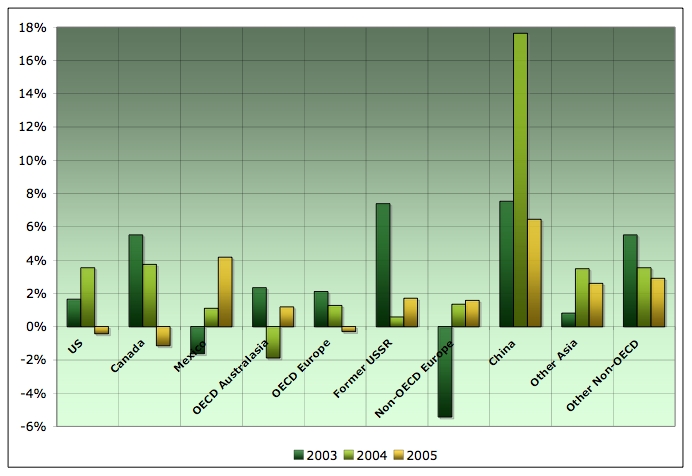
It did not. In fact, oil production capacity might actually grow sharply over the next few years (see chart 1). Cambridge Energy Research Associates (CERA), an energy consultancy, has scrutinised all of the oil projects now under way around the world. Though noting rising costs, the firm concludes that the world's oil-production capacity could increase by as much as 15m barrels per day (bpd) between 2005 and 2010—equivalent to almost 18% of today's output and the biggest surge in history. Since most of these projects are already budgeted and in development, there is no geological reason why this wave of supply will not become available (though politics or civil strife can always disrupt output).
Peak-oil advocates remain unconvinced. A sign of depletion, they argue, is that big Western oil firms are finding it increasingly difficult to replace the oil they produce, let alone build their reserves. Art Smith of Herold, a consultancy, points to rising “finding and development” costs at the big firms, and argues that the world is consuming two to three barrels of oil for every barrel of new oil found. Michael Rodgers of PFC Energy, another consultancy, says that the peak of new discoveries was long ago. “We're living off a lottery we won 30 years ago,” he argues.
It is true that the big firms are struggling to replace reserves. But that does not mean the world is running out of oil, just that they do not have access to the vast deposits of cheap and easy oil that are left in Russia and members of the Organisation of Petroleum Exporting Countries (OPEC). And as the great fields of the North Sea and Alaska mature, non-OPEC oil production will probably peak by 2010 or 2015. That is soon—but it says nothing of what really matters, which is the global picture.
When the United States Geological Survey (USGS) studied the matter closely, it concluded that the world had around 3 trillion barrels of recoverable conventional oil in the ground. Of that, only one-third has been produced. That, argued the USGS, puts the global peak beyond 2025. And if “unconventional” hydrocarbons such as tar sands and shale oil (which can be converted with greater effort to petrol) are included, the resource base grows dramatically—and the peak recedes much further into the future. {emphasis added}
After Ghawar"
It is also true that oilmen will probably discover no more “super-giant” fields like Saudi Arabia's Ghawar (which alone produces 5m bpd). But there are even bigger resources available right under their noses. Technological breakthroughs such as multi-lateral drilling helped defy predictions of decline in Britain's North Sea that have been made since the 1980s: the region is only now peaking.Globally, the oil industry recovers only about one-third of the oil that is known to exist in any given reservoir. New technologies like 4-D seismic analysis and electromagnetic “direct detection” of hydrocarbons are lifting that “recovery rate”, and even a rise of a few percentage points would provide more oil to the market than another discovery on the scale of those in the Caspian or North Sea.
Further, just because there are no more Ghawars does not mean an end to discovery altogether. Using ever fancier technologies, the oil business is drilling in deeper waters, more difficult terrain and even in the Arctic (which, as global warming melts the polar ice cap, will perversely become the next great prize in oil). Large parts of Siberia, Iraq and Saudi Arabia have not even been explored with modern kit.
The petro-pessimists' most forceful argument is that the Persian Gulf, officially home to most of the world's oil reserves, is overrated. Matthew Simmons, an American energy investment banker, argues in his book, “Twilight in the Desert”, that Saudi Arabia's oil fields are in trouble. In recent weeks a scandal has engulfed Kuwait, too. Petroleum Intelligence Weekly (PIW), a respected industry newsletter, got hold of government documents suggesting that Kuwait might have only half of the nearly 100 billion barrels in oil reserves that it claims (Saudi Arabia claims 260 billion barrels).
Tom Wallin, publisher of PIW, warns that “the lesson from Kuwait is that the reserves figures of national governments must be viewed with caution.” But that still need not mean that a global peak is imminent. So vast are the remaining reserves, and so well distributed are today's producing areas, that a radical revision downwards—even in an OPEC country—does not mean a global peak is here.
For one thing, Kuwait's official numbers always looked dodgy. IHS Energy, an industry research outfit that constructs its reserve estimates from the bottom up rather than relying on official proclamations, had long been using a figure of 50 billion barrels for Kuwait. Ron Mobed, boss of IHS, sees no crisis today: “Even using our smaller number, Kuwait still has 50 years of production left at current rates.” As for Saudi Arabia, most independent contractors and oil majors that have first-hand knowledge of its fields are convinced that the Saudis have all the oil they claim—and that more remains to be found.
Pessimists worry that Saudi Arabia's giant fields could decline rapidly before any new supply is brought online. In Jeremy Leggett's thoughtful, but gloomy, book, “The Empty Tank”, Mr Simmons laments that “the only alternative right now is to shrink our economies.” That poses a second big question: whenever the production peak comes, will it inevitably prompt a global economic crisis?The baleful thesis arises from concerns both that a cliff lies beyond any peak in production and that alternatives to oil will not be available. If the world oil supply peaked one day and then fell away sharply, prices would indeed rocket, shortages and panic buying would wreak havoc and a global recession would ensue. But there are good reasons to think that a global peak, whenever it comes, need not lead to a collapse in output.
For one thing, the nightmare scenario of Ghawar suddenly peaking is not as grim as it first seems. When it peaks, the whole “super-giant” will not drop from 5m bpd to zero, because it is actually a network of inter-linked fields, some old and some newer. Experts say a decline would probably be gentler and prolonged. That would allow, indeed encourage, the Saudis to develop new fields to replace lost output. Saudi Arabia's oil minister, Ali Naimi, points to an unexplored area on the Iraqi-Saudi border the size of California, and argues that such untapped resources could add 200 billion barrels to his country's tally. This contains worries of its own—Saudi Arabia's market share will grow dramatically as non-OPEC oil peaks, and with it the potential for mischief. But it helps to debunk claims of a sudden change.
The notion of a sharp global peak in production does not withstand scrutiny, either. CERA's Peter Jackson points out that the price signals that would surely foreshadow any “peak” would encourage efficiency, promote new oil discoveries and speed investments in alternatives to oil. That, he reckons, means the metaphor of a peak is misleading: “The right picture is of an undulating plateau.”
What of the notion that oil scarcity will lead to economic disaster? Jerry Taylor and Peter Van Doren of the Cato Institute, an American think-tank, insist the key is to avoid the price controls and monetary-policy blunders of the sort that turned the 1970s oil shocks into economic disasters. Kenneth Rogoff, a Harvard professor and the former chief economist of the IMF, thinks concerns about peak oil are greatly overblown: “The oil market is highly developed, with worldwide trading and long-dated futures going out five to seven years. As oil production slows, prices will rise up and down the futures curve, stimulating new technology and conservation. We might be running low on $20 oil, but for $60 we have adequate oil supplies for decades to come.”
The other worry of pessimists is that alternatives to oil simply cannot be brought online fast enough to compensate for oil's imminent decline. If the peak were a cliff or if it arrived soon, this would certainly be true, since alternative fuels have only a tiny global market share today (though they are quite big in markets, such as ethanol-mad Brazil, that have favourable policies). But if the peak were to come after 2020 or 2030, as the International Energy Agency and other mainstream forecasters predict, then the rising tide of alternative fuels will help transform it into a plateau and ease the transition to life after oil.
The best reason to think so comes from the radical transformation now taking place among big oil firms. The global oil industry, argues Chevron, is changing from “an exploration business to a manufacturing business”. To see what that means, consider the surprising outcome of another great motorcar race. In March, at the Sebring test track in Florida, a sleek Audi prototype R-10 became the first diesel-powered car to win an endurance race, pipping a field of petrol-powered rivals to the post. What makes this tale extraordinary is that the diesel used by the Audi was not made in the normal way, exclusively from petroleum. Instead, Shell blended conventional diesel with a super-clean and super-powerful new form of diesel made from natural gas (with the clunky name of gas-to-liquids, or GTL).
Several big GTL projects are under way in Qatar, where the North gas field is perhaps twice the size of even Ghawar when measured in terms of the energy it contains. Nigeria and others are also pursuing GTL. Since the world has far more natural gas left than oil—much of it outside the Middle East—making fuel in this way would greatly increase the world's remaining supplies of oil.
So, too, would blending petrol or diesel with ethanol and biodiesel made from agricultural crops, or with fuel made from Canada's “tar sands” or America's shale oil. Using technology invented in Nazi Germany and perfected by South Africa's Sasol when those countries were under oil embargoes, companies are now also investing furiously to convert not only natural gas but also coal into a liquid fuel. Daniel Yergin of CERA says “the very definition of oil is changing, since non-conventional oil becomes conventional over time.”
Alternative fuels will not become common overnight, as one veteran oilman acknowledges: “Given the capital-intensity of manufacturing alternatives, it's now a race between hydrocarbon depletion and making fuel.” But the recent rise in oil prices has given investors confidence. As Peter Robertson, vice-chairman of Chevron, puts it, “Price is our friend here, because it has encouraged investment in new hydrocarbons and also the alternatives.” Unless the world sees another OPEC-engineered price collapse as it did in 1985 and 1998, GTL, tar sands, ethanol and other alternatives will become more economic by the day (see chart 2).
This is not to suggest that the big firms are retreating from their core business. They are pushing ahead with these investments mainly because they cannot get access to new oil in the Middle East: “We need all the molecules we can get our hands on,” says one oilman. It cannot have escaped the attention of oilmen that blending alternative fuels into petrol and diesel will conveniently reinforce oil's grip on transport. But their work contains the risk that one of the upstart fuels could yet provide a radical breakthrough that sidelines oil altogether.
If you doubt the power of technology or the potential of unconventional fuels, visit the Kern River oil field near Bakersfield, California. This super-giant field is part of a cluster that has been pumping out oil for more than 100 years. It has already produced 2 billion barrels of oil, but has perhaps as much again left. The trouble is that it contains extremely heavy oil, which is very difficult and costly to extract. After other companies despaired of the field, Chevron brought Kern back from the brink. Applying a sophisticated steam-injection process, the firm has increased its output beyond the anticipated peak. Using a great deal of automation (each engineer looks after 1,000 small wells drilled into the reservoir), the firm has transformed a process of “flying blind” into one where wells “practically monitor themselves and call when they need help”.
The good news is that this is not unique. China also has deposits of heavy oil that would benefit from such an advanced approach. America, Canada and Venezuela have deposits of heavy hydrocarbons that surpass even the Saudi oil reserves in size. The Saudis have invited Chevron to apply its steam-injection techniques to recover heavy oil in the neutral zone that the country shares with Kuwait. Mr Naimi, the oil minister, recently estimated that this new technology would lift the share of the reserve that could be recovered as useful oil from a pitiful 6% to above 40%.
All this explains why, in the words of Exxon Mobil, the oil production peak is unlikely “for decades to come”. Governments may decide to shift away from petroleum because of its nasty geopolitics or its contribution to global warming. But it is wrong to imagine the world's addiction to oil will end soon, as a result of genuine scarcity. As Western oil companies seek to cope with being locked out of the Middle East, the new era of manufactured fuel will further delay the onset of peak production. The irony would be if manufactured fuel also did something far more dramatic—if it served as a bridge to whatever comes beyond the nexus of petrol and the internal combustion engine that for a century has held the world in its grip.

* σελ. A16-17 & σε λί δες Δ2 -6 
Look at it this way: More than 600 coal-fired electric plants in the United States produce 36 percent of U.S. emissions -- or nearly 10 percent of global emissions -- of CO2, the primary greenhouse gas responsible for climate change. Nuclear energy is the only large-scale, cost-effective energy source that can reduce these emissions while continuing to satisfy a growing demand for power. And these days it can do so safely.
I say that guardedly, of course, just days after Iranian President Mahmoud Ahmadinejad announced that his country had enriched uranium. ... And although I don't want to underestimate the very real dangers of nuclear technology in the hands of rogue states, we cannot simply ban every technology that is dangerous. ... In 1979, Jane Fonda and Jack Lemmon produced a frisson of fear with their starring roles in "The China Syndrome," a fictional evocation of nuclear disaster in which a reactor meltdown threatens a city's survival. Less than two weeks after the blockbuster film opened, a reactor core meltdown at Pennsylvania's Three Mile Island nuclear power plant sent shivers of very real anguish throughout the country.
What nobody noticed at the time, though, was that Three Mile Island was in fact a success story: The concrete containment structure did just what it was designed to do -- prevent radiation from escaping ... And although the reactor itself was crippled, there was no injury or death... Three Mile Island was the only serious accident in the history of nuclear energy generation in the United States, but it was enough to scare us away from further developing the technology: There hasn't been a nuclear plant ordered up since then.
Today, there are 103 nuclear reactors quietly delivering just 20 percent of America's electricity. ... And I am not alone among seasoned environmental activists in changing my mind on this subject. British atmospheric scientist James Lovelock, father of the Gaia theory, believes that nuclear energy is the only way to avoid catastrophic climate change. Stewart Brand, founder of the "Whole Earth Catalog," says the environmental movement must embrace nuclear energy... On occasion, such opinions have been met with excommunication from the anti-nuclear priesthood...
There are signs of a new willingness to listen, though, even among the staunchest anti-nuclear campaigners. ... Here's why: Wind and solar power have their place, but because they are intermittent and unpredictable they simply can't replace big baseload plants such as coal, nuclear and hydroelectric. Natural gas, a fossil fuel, is too expensive already, and its price is too volatile to risk building big baseload plants. Given that hydroelectric resources are built pretty much to capacity, nuclear is, by elimination, the only viable substitute for coal. It's that simple.
That's not to say that there aren't real problems -- as well as various myths -- associated with nuclear energy. Each concern deserves careful consideration:
- Nuclear energy is expensive. It is in fact one of the least expensive energy sources. ... Advances in technology will bring the cost down further in the future.
- Nuclear plants are not safe. Although Three Mile Island was a success story, the accident at Chernobyl, 20 years ago this month, was not. But Chernobyl ... had no containment vessel, was an inherently bad design and its operators literally blew it up. ... 56 deaths could be directly attributed to the accident... Tragic as those deaths were, they pale in comparison to the more than 5,000 coal-mining deaths that occur worldwide every year. ...
- Nuclear waste will be dangerous for thousands of years. Within 40 years, used fuel has less than one-thousandth of the radioactivity it had when it was removed from the reactor. And it is incorrect to call it waste, because 95 percent of the potential energy is still contained in the used fuel after the first cycle. Now that the United States has removed the ban on recycling used fuel, it will be possible to use that energy and to greatly reduce the amount of waste...
- Nuclear reactors are vulnerable to terrorist attack. The six-feet-thick reinforced concrete containment vessel protects the contents from the outside as well as the inside. And even if a jumbo jet did crash into a reactor and breach the containment, the reactor would not explode. There are many types of facilities that are far more vulnerable, including liquid natural gas plants, chemical plants and numerous political targets.
- Nuclear fuel can be diverted to make nuclear weapons. This is the most serious issue associated with nuclear energy and the most difficult to address, as the example of Iran shows. But just because nuclear technology can be put to evil purposes is not an argument to ban its use.
Over the past 20 years, one of the simplest tools -- the machete -- has been used to kill more than a million people in Africa, far more than were killed in the Hiroshima and Nagasaki nuclear bombings combined. What are car bombs made of? Diesel oil, fertilizer and cars. If we banned everything that can be used to kill people, we would never have harnessed fire. ...
The 600-plus coal-fired plants emit nearly 2 billion tons of CO2annually -- the equivalent of the exhaust from about 300 million automobiles. ... coal plants are responsible for 64 percent of sulfur dioxide emissions, 26 percent of nitrous oxides and 33 percent of mercury emissions. These pollutants are eroding the health of our environment, producing acid rain, smog, respiratory illness and mercury contamination.
Meanwhile, the 103 nuclear plants operating in the United States effectively avoid the release of 700 million tons of CO2emissions annually -- the equivalent of the exhaust from more than 100 million automobiles. Imagine if the ratio of coal to nuclear were reversed so that only 20 percent of our electricity was generated from coal and 60 percent from nuclear. This would go a long way toward cleaning the air and reducing greenhouse gas emissions. Every responsible environmentalist should support a move in that direction.
Exxon is also spreading the message to shareholders that it expects to be contributing directly to that production increase. In a presentation to Wall Street analysts last week, new CEO Rex Tillerson said the company's oil production could grow by 3% per year over the next five years.
One purpose of such announcements is to address the concerns of those who say companies like ExxonMobil have not been reinvesting enough of their profits in new oil production and refinery capacity. In his statement before the analysts, Tillerson noted that over the last 15 years, the company has consistently invested more than it earned.
Source: Oil Drum |
 |
As I noted here, comparing gross investment with net income is in some ways comparing apples and oranges. The reason is that oil companies must invest huge sums just to replace depleted oil fields and obsolete and worn-out equipment. These imputed depletion and depreciation costs are already subtracted from revenues before one arrives at profits. The question is not how big is gross investment relative to net income but rather how big is net investment-- investment over and above what is required for depletion and depreciation-- relative to net income. I would expect the long-run ratio of net investment to net income for a healthy industry with solid investment opportunities to be somewhere around 50%. My earlier post pointed out that in 2004, ExxonMobil's net income came to $26 billion, but, depending on how you do the accounting, you could actually arrive at a negative value for their net investment for 2004.
Another way to cut through the accounting is to count the teeth and look at how much oil ExxonMobil's actually been producing. The green line on the graph at the right gives ExxonMobil's crude oil and natural gas liquid production over the last decade, with the 2005 entry based on the second quarter; (more on the purple line shortly). If ExxonMobil has indeed been making big investments beyond those needed to replace depleted oil fields, they don't have a lot to show for it so far. Yes, in gross terms they invested a huge amount. But, as the graph reveals, you have to do that in this business just to stay in the same place.
Granted, the company is currently favorably situated in a number of big projects that should be producing a lot of new oil in the near future, and just finished negotiating a nice cut of Indonesia's Cepu field. The question is, how much of that new production will be needed just to replace declining production from existing fields?
Which reminds me, I said I'd explain the meaning of the purple line. That's the projection from Exxon's 2001 Annual Report, in which the company predicted that their oil and gas production capacity would grow by 3% per year between 2001 and 2007.
"President George W. Bush has an uncanny ability not to see the big message. For years, it has become increasingly clear that much is amiss with his energy policy. Scripted by the oil industry, even members of his own party referred to an earlier energy bill as one that “left no lobbyist behind.” While praising the virtues of the free market, Bush has been only too willing to give huge handouts to the energy industry...
There is a market failure when it comes to energy... The fact that Americans do not pay the full price for the pollution – especially enormous contributions to greenhouse gases – that results from their profligate energy use means that energy is under-priced, in turn sustaining excessive consumption. The government needs to encourage conservation, and intervening in the price system – namely, through taxes on energy – is an efficient way to do it. But, rather than encouraging conservation, Bush has pursued a policy of “drain America first,” leaving America more dependent on external oil in the future. ...
Now, ... Bush appears to have finally woken up to the reality of America’s increasing dependence; with soaring oil prices, it was hard for him not to note the consequences. But, again, his administration’s faltering moves will almost surely make matters worse in the immediate future. Bush still refuses to do anything about conservation, and he has put very little money behind his continuing prayer than technology will save us.
What, then, to make of Bush’s recent declaration of a commitment to make America 75% free of dependence on Middle East oil within 25 years. For investors, the message is clear: do not invest more in developing reserves in the Middle East, which is by far the lowest-cost source of oil in the world.
But, without new investment in developing Middle East reserves, unbridled growth of energy consumption in the US, China, and elsewhere implies that demand will outpace supply. If that were not enough, Bush’s threat of sanctions against Iran poses the risks of interruptions of supplies from one of the world’s largest producers. With world oil production close to full capacity and prices already more than double their pre-Iraq War level, this portends still higher prices, and still higher profits for the oil industry – the only clear winner in Bush’s Middle East policy.
To be sure, one shouldn’t begrudge Bush for having at last recognized that there is a problem. But, as always, a closer look at what he is proposing suggests another sleight of hand by his administration. Aside from refusing to recognize the importance of global warming, encourage conservation, or devote enough funds to research to make a real difference, Bush’s grandiose promise of a reduction of dependence on Middle East oil means less than it appears. With only 20% of US oil coming from the Middle East, his goal could be achieved by a modest shift of sourcing elsewhere.
But surely, one would think, the Bush administration must realize that oil trades on a global market. Even if America were 100% independent of Middle East oil, a reduction in supply of Middle East oil could have devastating effects on the world price – and on the American economy.
As is too often the case with the Bush administration, there is no flattering explanation of official policy. Is Bush playing politics by pandering to anti-Arab and anti-Iranian sentiment in America? Or is this just another example of incompetence and muddle? From what we have seen over the past five years, the correct answer probably contains more than a little bad faith and sheer ineptitude."
"Such a sea level rise would permanently inundate low-lying lands like New Orleans, southern Florida, Bangladesh and the Netherlands. Already sea level rise has increased to an inch per decade... And evidence that the Arctic is exponentially warming continues to accumulate. ... "We need to start serious measures to reduce greenhouse gases within the next decade," ... "If we don't do something soon, we're committed to [13 to 20 feet] of sea level rise in the future."

What is the right way to look at it, according to Summers? Daly says it is something like Figure 2, where the ecological context has been removed and, therefore, the circular flow of economic growth appears to be free from any natural limits beyond the economic system. This is not just Summers' radical vision of the economy. It represents the orthodox view of the great majority of economists who, if not outwardly hostile to the ecological view, generally set it aside as irrelevant to the analysis at hand.

Recalling Joseph Schumpeter's notion of a pre-analytic vision, Daly summed up this fundamental economic dilemma that divides so many economists, politicians, and citizens:
"Unless one has the preanalytic vision of the economy as subsystem, the whole idea of sustainable development—of a subsystem being sustained by a larger system whose limits and capacities it must respect—makes no sense whatsoever. On the other hand, a preanalytic vision of the economy as a box floating in infinite space allows people to speak of "sustainable growth"—a clear oxymoron to those who see the economy as a subsystem. The difference between these two visions could not be more fundamental, more elementary, or more irreconcilable." (Beyond Growth, p. 7)
I agree that these competing visions are fundamentally anti-thetical as they have been presented, by Daly, Summers, and countless other economists over the years. They are so antithetical that even a veritable encyclopedia of economic thought like Mark Blaug's otherwise breathtaking 700-page Economic Theory in Retrospect completely ignores the ideological challenge presented by the ecological vision of the economy--a challenge which, in partial defense of Blaug, has been largely ignored by most of the economists of the past 250 years. But just because this ecological view of the economy has been marginalized by the more dominant schools of thought does not mean that it is wrong, nor that it has necessarily failed in the overrated "efficient market in economic ideas."
Regardless, the compelling thing about this particular ideological debate is that the objects of the debate, Earth's natural systems, don't much care whether or not they prevail in some intellectual discussion among the various schools of economic thought. Natural systems have a unique way of asserting their perspectives on human economic activity without regard for human priorities and convictions and without need for human understanding and consensus. Still, we are fools if we choose to wait for the world ecosystem to break the ideological impass between ecological and non-ecological economists.
Where I disagree with Daly's assessment of the economic dilemma is in his claim that these pre-analytic visions are irreconcilable. I think they can be reconciled within a more integral vision that honors the partial truth in each, while providing some practical guidelines for post-visionary analyses of sustainable economic growth. As I see it (Figure 3), the physical dimension of the economy, which can be measured in terms of the scale of material, energy, chemical, and biological throughput, does indeed comprise an economic sub-system of the world's physical biosphere, which includes the sources and sinks for the economic throughput. This is the partial truth in the ecological vision of the economy and it affirms the existence of certain physical limits to the scale of economic growth--but, strictly speaking, these limits only apply to physical economic growth.
In my view, the economy also has a non-physical, or mental dimension--psychological development, intersubjective exchange, subjective valuation, intellectual capital--that contributes to the overall depth of economic growth. The mental economy is inextricably linked to, and entirely dependent upon, the physical economy, which is, in turn, governed by the natural logic and limits of the Earth's physical systems. However, the mental economy is not a sub-system of the Earth's physical biosphere and it is not governed directly by the rules of the natural world. Quite the opposite. The mental economy, for better and for worse, is where we make all our economic decisions and direct the economic growth in two-dimensions--mental depth and physical scale. Beyond this, I find it useful to frame the mental economy as a sub-system/culture within a more encompassing mental super-system/culture that we might define as the non-physical, depth dimension of human civilization. Following the philosopher Ken Wilber, we may call this the noosphere in relation to the biosphere. Wilber has been particularly articulate about the contrast between the depth of the noosphere and the scale (though he calls it span) of the biosphere--I think these distinctions apply equally well to the economy. This reframing reveals the partial truth in the orthodox view of economic growth beyond the scale of ecological limits--but this truth is only valid to the extent that we are speaking of non-physical economic growth.

When it comes to economic growth, households and the factors of production they supply to firms, as well as firms and the products they supply to households, all have a physical scale dimension that is subject to the logic and limits of the physical world and a mental depth dimension that is subject to the logic and limits of the mental world (hence the checkerboard pattern of green scale and yellow depth). In addition to natural resources, the other classical factors of production, labor and capital, also have physical properties that contribute to the growing scale of the economy. And although the common differentiation between products, services, and experiences is intended to denote a gradation from physical to mental, we should remember that even the most ethereal of experience-goods has a physical component and even the most material of commodities has some mental component that is part of the cycle of two-dimensional growth.
People can reasonably disagree on the precise scale of the physical economy and therefore the timing of our future encounters with the biospheric limits to physical economic growth. But reasonable people, in my opinion, cannot deny the fact that there are very real limits to the physical growth of the economy. Given this premise, its seems entirely sensible to promote economic growth that is progressively less physical and more mental until such time as we can enjoy economic growth that is truly sustainable--limited in scale, yet mentally innovative, enriching, and developmental. Innovators like Amory Lovins have demonstrated how superior design can yield products whose physical-to-mental ratio is much lower than competing products, at the time of sale and over the useful life of the product, while still providing the same essential service as the more physically-intensive alternative (e.g., hypercars vs. SUVs).
To the extent that we adopt either of the partial visions of the economy, I believe we create patterns of unsustainable economic action. An exclusive application of the non-ecological vision may result in a pattern of economic growth that is physically unsustainable, relying on eventual, but certain, ecological crises to force policy makers, business leaders, and market participants to learn, in the double-loop sense, their way out of the unsustainable patterns. Similarly, if we were to apply only the ecological vision and pursue a strategy of zero economic growth, we might lock a majority of the world's population into poverty and perhaps, ironically, preclude the economic innovations that would otherwise, in time, establish the foundation for an integral economy that is physically sustainable, yet mentally growing. Calling for limits to all growth is just as unsustainable as ignoring all limits to growth.
What puzzles me about Daly's brilliant book, which outlines in considerable detail the post-visionary analyses that he believes to be consistent with his pre-analytic vision (Figure 1), is that his post-visionary analyses are actually much more consistent with my pre-analytic vision (Figure 3). But I wonder if he and his readers have realized this inconsistency, obscured as it is by some semantic issues.
First, Daly chooses not to use the standard economic definition of the word growth, which is basically a change in the aggregate prices of the economic product, such as Gross Domestic Product. He prefers instead to re-define growth as a change in the physical scale of this economic product, measured not in money prices but in matter-energy flows. This re-definition is the less-than-obvious justification for his unequivocal claims that sustainable economic growth is an oxymoron, an impossibility theorem. In my opinion, the very large number of people, both critical and supportive, who believe that Daly and other ecological economists are against all economic growth, as in GDP, has its origin in this unnecessary re-definition of the term growth.
Second, Daly adopts the term development to denote the non-quantitative, qualitative improvement component of the growth in economic product, consistent with what I have referred to generally as the mental depth dimension of economic growth. This allows him to build his case against the re-defined and exclusively quantitative growth while still acknowledging that qualitative development may continue. More than just another semantic issue, this is actually inconsistent with his espoused pre-analytic vision (Figure 1), which allows no room for what he calls development, and only reinforces the first problem of his perceived indictment of all growth.
Finallly, and perhaps most importantly, Daly doesn't seem to acknowledge that his versions of quantitative growth and qualitative development are both measured quantitatively in terms of money prices and therefore, as I said above, contribute to what everyone else calls economic growth--e.g., changes in GDP. It's not that he isn't reflectively aware of this (obviously he is), it's that he repeatedly critiques all quantitative growth while occasionally acknowledging the value of purely qualitative development without emphasizing that both really do contribute to what everyone else in the world sees as quantitative economic growth. It's no wonder that so many people think that Daly and other ecological economists are against all quantitative economic growth: because they are, and yet they aren't, depending upon which definition one is using.
This reveals a shortcoming in all three of the above figures, which ignore the flow of currency that runs counter to the flow of production and consumption. This currency flow, depicted in Figure 4, is the index that everyone really uses to measure economic growth, because we do not have any other way to quantitatively measure aggregate product or the aggregate factors of production except for the aggregate prices they yielded in exchange. The dizzying variety of economic products and factors of production are incommensurable without money prices. When we factor into this slightly more integral vision of the economy our understanding of currency design and the inherent need for sustainable growth in money and credit independent of any growth in physical or mental product, we see just how important it is to include the counter-cyclical flow of income and expenditures and just how difficult it is to convince anyone that economic growth, however it is defined, must cease. My bottom line on Daly's book: it is an outstanding read by a brilliant heterodox economist, full of insightful critiques and valuable contributions to the economic dialogue, though it can be more clearly understood by supporters and critics alike if reconstructed to fit the pre-analytic vision depicted in Figure 4.

In the reconciliation of a more Integral Economics, sustainable growth is not an oxymoron, but a double entendre, denoting the very real possibility of sustainable economic growth that satisfies the very real necessity of economic growth that is sustainable. The key to the riddle is that there are two kinds of growth--scale and depth--that are being measured in units of the same common medium, money prices, and fused into a single, undifferentiated indicator of economic growth. The primary goal of our post-visionary analysis is therefore to craft public policies, business strategies, and personal practices that will move the economy toward a pattern in which physical growth is systematically replaced by mental growth even while overall growth in terms of aggregate prices continues to rise.
"3) The U.S. economy grows as an integrated whole consisting of agricultural, extractive, manufacturing, and services sectors (and the supporting infrastructure) that requires physical inputs of non-renewable resources, land and water, and that produces wastes, and;
4) Economic growth is usually measured by increasing gross domestic product, although this is an inadequate indicator of human welfare, and;
Yep.
5) Economic growth has long been a primary policy goal of U.S. society and government because of the belief that it leads to an enhanced quality of life, and;
That's why most environemtal economists I know would never strictly equate increases in GDP to increases in well-being.
6) Economic growth occurs in a finite and depletable biophysical context, and;
And?
7) Continuing non-renewable, resource-intensive economic growth is having unintended damaging consequences for ecosystems and human societies;
I like to call these 'externalities.'
Therefore, the United States Society for Ecological Economics takes the position that based on the above evidence:
1) There is a fundamental conflict between economic growth and ecosystem health (in such areas as biodiversity conservation, clean air and water, atmospheric stability), and;
OK, I think I might disagree with this just a little. By using the straw-man definition of economic growth, this turns into a tautology. 'Economic growth that uses ecosystem inputs but doesn't count them, uses ecosystem inputs but doesn't count them.'
2) There is a fundamental conflict between economic growth and the ecological services underpinning the human economy (for example, pollination, decomposition, climate regulation), and;
This is where my views start to depart from the ecol-econ view, I think. Such statements are without context and in my opinion lack prescriptive value. It is too easy to pick up on such statements and interpret them as "economic growth and environmental protection are incompatible. Therefore economic growth is bad."
3) Although technological progress and unregulated markets have had many positive effects they cannot be depended upon to fully reconcile the conflict between economic growth and the long-term ecological and social welfare of the U.S. and the world, and;
That's why environmental economists are concerned with measuring economic welfare in the context of human-environmental interaction.
4) A sustainable economy (that is, an economy with a relatively stable, mildly fluctuating product of population and per capita consumption) is a viable alternative to a growing economy and has become a more appropriate goal for the U.S. and other large, wealthy economies, and;
Sustainability does not have to mean economic stagnation.
5) A long-run sustainable economy requires its establishment at a size small enough to avoid the breaching of ecological and economic capacity (especially during supply shocks such as droughts and energy shortages), efficient use of energy, materials and water, and an accelerated shift toward the use of renewable energy sources, and;
Hard to argue with. I think many environmental economists make similar arguments.
6) A sustainable economy supports economic development, a qualitative process in which human welfare is increased through strategic changes in the relative prominence of economic sectors and techniques. ;
Am I to read this as 'big business bad?" I get that feeling.
7) While establishing a sustainable economy, it would be advisable for the U.S. to assist other nations in moving from the goal of economic growth to the goal of a sustainable economy, beginning with those nations currently enjoying adequate per capita consumption, and;
Umm...don't we get in trouble for things like this? Sorry I'll lean back to the left now.
8) For many nations with widespread poverty, increasing per capita consumption though economic growth and often via more equitable distributions of wealth remains an appropriate goal. ;
In short, I think there are very few things on this list that I disagree with. Does that make me an ecological economist? Probably, but no more so than most ecological economists are environmental economists. I'm not saying there aren't differences in the ways we think about the economic-ecosystem interaction, but that's why we have discourse and why John and I welcome sites like Ecological Economics."So only poor nations should target economic growth? Doesn't that put them in the exact same place as we are now? Why advocate policies for poor countries that you argue caused the mess we're in in the first place? Doesn't seem to follow. Why not advocate policies for sustainable development and growth in ALL countries?
Ocean surface temperatures have been rising over time and several studies have linked this increase to more frequent hurricanes, but not in a way that completely eliminates natural processes as an alternative explanation. This study helps to remove some of the doubt about the link between surface temperatures and hurricane frequency:
Intense Storms Tied to Rising Ocean Temperature, by Valerie Bauerlein, WSJ: A new study published yesterday in the online edition of the journal Science says rising ocean temperatures around the globe are to blame for the surge of intense hurricanes that has slammed the U.S. and other countries in recent years -- a finding likely to further roil the debate over whether human activity is triggering more-devastating storms. The study ... concluded that the sharp increase in the number of very intense hurricanes can't be attributed to a normal weather cycle or other natural explanations. ...

Scientific American has more on the analysis.
Nowadays southern Californians fight over water in courts of law. Angelenos [are]... piping in water from hundreds of miles away and draining a Colorado River so depleted that it barely reaches the sea. ...it means disputing every drop of the Colorado with Arizona. The Mulholland model represents a brutish form of what has been a global approach to water management. Want to urbanize and industrialize at breakneck speed? Then dam and divert your rivers to meet the demand. Want to expand the agricultural frontier? Then mine your aquifers and groundwaters. ...
Water is being pumped out of the aquifer on which Mexico City stands at twice the rate of replenishment. The result: the city is subsiding at the rate of about half a meter every decade... The mining of groundwaters for irrigation has lowered the water table in parts of India and Pakistan by 30 meters in the past three decades. As water goes down, the cost of pumping goes up, undermining the livelihoods of poor farmers. Meanwhile, a lethal combination of water shortages, soil salination, and waterlogging threatens the breadbaskets of both countries. In India, about one quarter of grain production is based on unsustainable groundwater use. In China, urbanization and rapid growth has ... left a water crisis of epic proportions. The Hai-Huai-Yellow river basin tells its own story. More than 80 percent of river lengths are chronically polluted...
What is driving the global water crisis? Physical availability is part of the problem. ... With water use increasing at twice the rate of population growth, the amount available per person is shrinking - especially in some of the poorest countries. Over the next 25 years, the number of people living in countries with water crises will increase from 700 million to 2.2 billion, with more than half of the populations of South Asia and sub-Saharan Africa affected. Factor in global warming, which could reduce rainfall in parts of sub-Saharan Africa by up to a quarter over the next century, and this is starting to look like a crisis in the making...
Growing scarcity means more competition. And as William Mulholland taught us all those years ago, competition without good governance can turn ugly - especially for those without power. ... The danger is that the poorest farmers with the weakest voice in water management will lose out, with devastating consequences for global poverty reduction efforts. Challenging as physical scarcity may be in some countries, the real problems in water go deeper. The 20th-century model for water management was based on a simple idea: that water is an infinitely available free resource to be exploited, dammed or diverted without reference to scarcity or sustainability.
Forty years ago, the Aral Sea covered an area the size of Belgium. Thanks to Soviet-era planners who diverted the ... rivers into cotton irrigation, it has been reduced to a couple of small, lifeless hypersaline lakes. In the United States, farmers on the High Plains are pumping water from the Ogallala aquifer ... at eight times the recharge rate. ...
Across the world, water-based ecological systems - rivers, lakes and watersheds - have been taken beyond ... ecological sustainability by policy makers who have turned a blind eye to the consequences of over- exploitation. We need a new model of water management for the 21st century. What does that mean? For starters, ... that means using it more efficiently at levels that do not destroy our environment. ... it means is that governments need to manage the private demand of different users and manage this precious resource in the public interest.
There is another, equally profound challenge. In an era of intensifying competition, we have to ensure that the world's poor do not suffer... That means strengthening the rights and the voice of the poor - and it means putting social justice at the center of water management.